
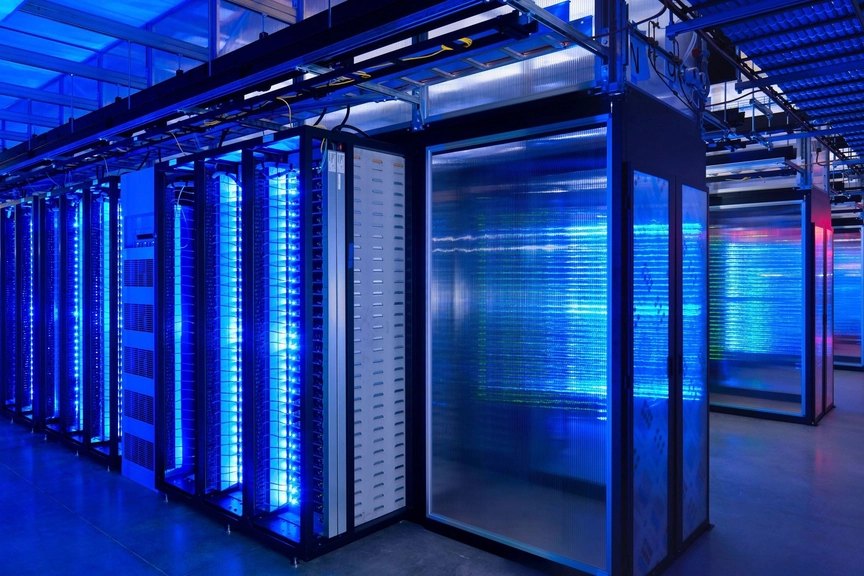
America’s $10tn AI infrastructure boom is starting to fray as hyperscale data centers push toward 100,000-card clusters, bringing critical bottlenecks in electrical grid capacity and thermal management. On the ground, the expansion of artificial intelligence has made electricity access and site selection a matter of industrial policy, competition policy, and environmental assessment, according to Wikipedia.
Scaling to 100,000-Card Superclusters
AI infrastructure comprises the physical and software systems used to develop, train, deploy, and operate artificial intelligence models and applications, according to Wikipedia. In a narrow sense, the term refers to physical computing resources including semiconductors, processors, memory, servers, storage, networking equipment, and data centers. Modern AI systems run on central processing units and on specialized accelerators that perform large numbers of operations in parallel, such as graphics processing units, application-specific integrated circuits, and field-programmable gate arrays. Different workloads use different combinations of processors, with large-scale model training commonly relying on accelerators while some inference and supporting tasks run on general-purpose CPUs.
Accelerators are assembled into servers and then into clusters. The industry is currently transitioning from 10,000-card deployments to 100,000-card superclusters. An example of this trend is the Sugon 8000, China’s first fully homegrown 100,000-card AI supercluster, which debuted at the China National Annual Conference on High Performance Computing, according to CCTV News. Scaling to 100,000-card clusters means interconnecting 100,000 AI accelerator cards at high speed. According to telecommunications analyst Ma Jihua, such systems require high-speed interconnects, storage throughput, liquid cooling, workload scheduling, and long-term stability, all of which pose major engineering challenges.
The Grid Interface Crisis
Hyperscale data center loads are creating new challenges for utility providers and grid operators, according to Data Center Frontier. The massive electricity demands of these facilities strain local and national power supplies. Oracle has called for standardized interfaces between AI data centers and power grids to manage demand, according to Data Center Frontier. Without clear coordination standards, utility providers struggle to keep pace with the power density required by modern accelerator clusters.
Co-Design Strategies for Power and Performance
To address thermal management and power constraints, the industry is moving away from one-size-fits-all infrastructure toward heterogeneous, workload-specific architectures, according to Intel and Hewlett Packard Enterprise cited by Data Center Frontier. Microsoft is focusing on full-stack co-design strategies, such as its Maia 300 roadmap, to optimize AI inference performance per watt and per dollar, according to Data Center Frontier. Google is applying artificial intelligence directly to hardware design, data center operations, capacity planning, and infrastructure efficiency, according to Data Center Frontier.
Integration is also taking structural forms within advanced computing systems. The Sugon 8000 demonstrates a computing system built explicitly around the native convergence of supercomputing and intelligent computing within a unified architecture, capable of running both high-precision scientific computing and large model training and inference, according to CCTV News. Liu Gang, director of the Institute of Economic Research at Nankai University, noted that integrating high-performance computing and AI computing enables resource allocation according to specific task requirements, improving resource efficiency for diverse scientific and industrial applications.
The Shift Toward Integrated System Coordination
As power and cooling limits constrain raw hardware scaling, the artificial intelligence industry is shifting its focus toward integrated system coordination. Infrastructure no longer relies solely on raw processor counts, because usefulness depends on associated memory, storage, networking, and systems software. Shared facilities house both general-purpose and accelerated computing, but differing processor types, interconnect requirements, power densities, and costs require careful management. By moving from isolated scaling metrics to coordinated hardware and software co-design, operators aim to sustain the deployment of large-scale AI workloads despite tightening physical constraints.
The Role of Software and Supply Chain Integration
Beyond physical hardware, the broader AI infrastructure stack includes essential software components such as drivers, compilers, machine-learning frameworks, cloud platforms, and resource-management systems, according to Wikipedia. These software layers are critical because they make the raw hardware usable for developing, training, and operating AI models. Because the usefulness of a cluster depends on the interplay between processors, memory, storage, networking, and systems software, processor counts alone do not fully describe the capacity of an AI system.
The semiconductor supply chain that underpins these deployments involves complex processes including chip design, manufacturing equipment, fabrication, packaging, and materials, according to Wikipedia. As the industry transitions to 100,000-card superclusters, this supply chain must support the integration of diverse computing requirements. The Sugon 8000, for instance, has already undergone extensive optimization for over 300 key applications across more than 30 research and industrial fields, with over 20 applications running on the full system. This indicates that modern infrastructure is moving from mere construction to practical, large-scale use, with systems designed to support simultaneous model training, data analysis, and scientific simulation. By utilizing unified scheduling and high scaling efficiency, these integrated systems aim to help enterprises cut research and development costs and shorten innovation cycles.
Engineering Hurdles: Liquid Cooling, Interconnects, and Power Density
Scaling to 100,000-card clusters introduces significant engineering challenges beyond raw hardware counts, particularly in thermal management and electrical delivery. According to Ma Jihua, a senior telecommunications analyst, such systems require high-speed interconnects, storage throughput, liquid cooling, workload scheduling, and long-term stability, all of which pose major engineering challenges.
Liquid cooling has become essential as power density increases with the deployment of dense accelerator clusters, where traditional air cooling is insufficient to manage heat dissipation at scale. The Sugon 8000, China’s first fully homegrown 100,000-card AI supercluster, exemplifies this shift, incorporating liquid cooling to support sustained operation of its high-density computing nodes under intense workloads.
Interconnects must also scale to maintain low-latency, high-bandwidth communication between 100,000 accelerator cards, a requirement emphasized by Ma Jihua as critical for system performance and stability. Without advances in interconnect technology, storage throughput, and coordinated workload scheduling, the full potential of large-scale AI clusters cannot be realized, even if raw processor counts are met.
Sources
- AI infrastructure
- OCP 2026: AI Infrastructure Moves From Scaling to Coordination
- China unveils first 100,000-card AI supercluster hardware, showcases 10 frontier research applications




