
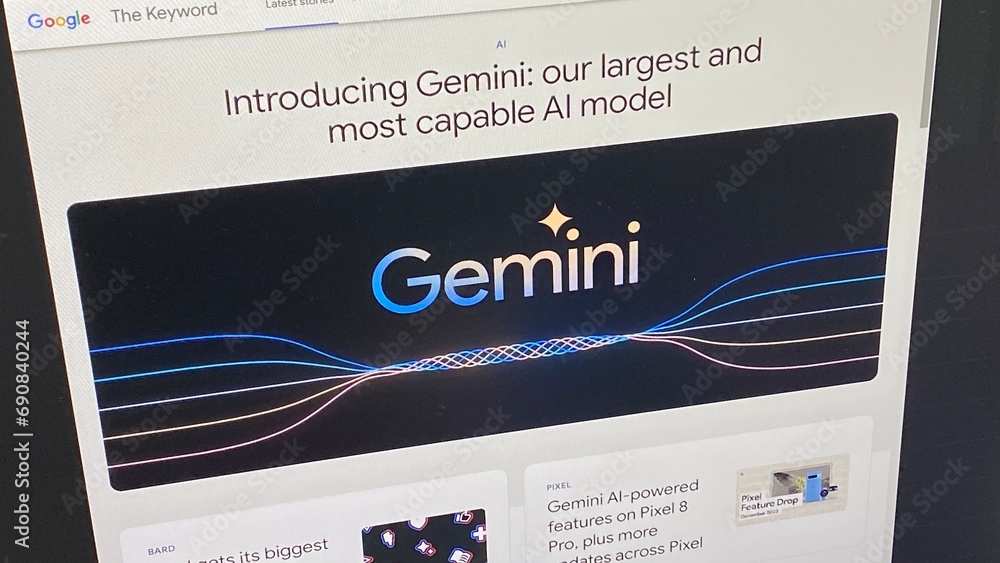
On December 6, 2023, Google DeepMind announced Gemini, a new family of multimodal large language models (LLMs) designed to power a range of applications, including a chatbot of the same name. This launch marks a significant step in the evolution of Google’s AI capabilities, positioning Gemini as the successor to earlier models LaMDA and PaLM 2.
The Gemini family is comprised of several distinct models tailored for different use cases. These include Gemini Pro, intended for scaling across a wide variety of tasks; Gemini Deep Think, which focuses on more complex reasoning; Gemini Flash, optimized for speed and efficiency; and Gemini Flash Lite, a lighter version for more constrained environments. All models in the family are multimodal, meaning they are capable of processing and integrating multiple types of data, such as text, images, audio, and video, rather than being limited to a single format like text alone.
Developed by Google DeepMind, the AI research lab formed from the merger of Google Brain and DeepMind, Gemini represents a direct evolution from the company’s previous LLM efforts. Its predecessors, LaMDA and PaLM 2, established Google as a major player in the generative AI space, but Gemini was designed from the ground up to be more versatile and efficient. The announcement on December 6, 2023, was accompanied by demonstrations of the model’s capabilities, including its ability to understand and reason across different types of information, such as interpreting a hand-drawn diagram or answering questions about a video clip.
One of the key features of Gemini is its integration into Google’s existing ecosystem. The Gemini chatbot, which is powered by the model family, is available to users through various Google services. This integration allows the model to be used for tasks like summarizing emails, generating creative content, or providing information in a conversational format. The company has emphasized that Gemini is designed to be a more capable and safer AI system than its predecessors, with built-in safeguards to prevent misuse and ensure responsible deployment.
The launch of Gemini has been closely watched by the AI industry, as it directly competes with other leading models, such as OpenAI’s GPT-4 and Anthropic’s Claude. While Google has not released detailed performance benchmarks for all versions of Gemini, the company has claimed that the model achieves state-of-the-art results on several academic benchmarks, particularly in multimodal understanding and reasoning tasks. This has led to comparisons with other frontier models, though independent verification of these claims is ongoing.
As with any major AI release, Gemini has also sparked discussions about the broader implications of advanced language models. Concerns about bias, misinformation, and the potential for job displacement remain central to the public conversation. Google DeepMind has stated that it is committed to responsible AI development and has implemented measures to address these issues, including extensive testing and feedback from external experts. The company has also made some versions of Gemini available to developers through APIs, encouraging innovation while maintaining oversight.
Looking ahead, the next major milestone for Gemini will be its broader rollout and the continued refinement of its capabilities. Observers will be watching for how the model performs in real-world applications, particularly in areas like education, healthcare, and creative work. Additionally, the release of more specialized versions, such as Gemini Deep Think, could signal a shift toward AI models that are not just faster or larger, but also more capable of deep, nuanced reasoning. As Google DeepMind continues to iterate on the Gemini family, the AI landscape is likely to see further competition and innovation, with Gemini positioned as a key player in the ongoing evolution of generative AI.





















 designed to power a range of applications,...)