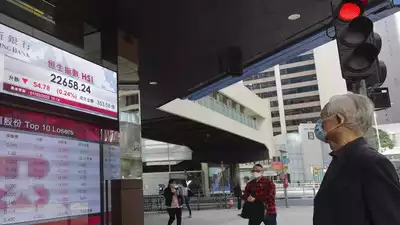
For millions of people around the world, the recent fluctuations in the stock market have had a direct impact on their lives. From investors to workers, the effects of economic uncertainty can be felt in communities everywhere. In Asia, where stocks have been edging up despite global growth worries, the human impact is particularly significant. In China, for example, the government’s decision to loosen its strict anti-COVID policy has brought a sense of relief to many, as it is expected to boost the country’s economy, which is the second-largest in the world.
The rise in Asian shares, led by Hong Kong and China stocks, has been a welcome development for many investors. The MSCI, the biggest Asia-Pacific share index outside of Japan, was up 0.19%, ending a two-day losing trend. Hong Kong’s Hang Seng Index surged by over 2%, while China’s stock market increased by 0.12%. This increase followed some investors taking profits on Wednesday, after the government announced significant measures to loosen its anti-COVID policy. However, not all markets have been affected equally, with the S&P/ASX 200 index in Australia plummeting by 0.67% and the Nikkei in Japan dropping to close to a one-month low.
Economic Uncertainty
The global economy is facing numerous challenges, including an impending economic slowdown and the speed at which the Federal Reserve is raising interest rates. The trend in U.S. worker productivity, which recovered at a somewhat faster pace than previously believed in the third quarter, has been sluggish, keeping labor costs high. This has made it difficult for the market to find direction, with investors’ willingness to take on risk curbed by growing concerns that the U.S. central bank may continue its extended rate-hike cycle. The U.S. Treasury market, which appears to be moving with little support, has also put pressure on the stock market, according to Rob Carnell.
The benchmark S&P 500 declined for the fifth straight session on Wednesday, and the tech-heavy Nasdaq also finished lower for the fourth day running. The dollar index increased by 0.171%, the euro fell by 0.05% to $1.05, and the sterling was last trading at $1.2184, down by 0.12% for the day. After falling to their lowest point of the year on Thursday, oil prices stabilized in early Asian trading, with U.S. crude increasing by 0.96% to $72.70 a barrel, and Brent up 0.8% for the day at $77.79.
Interest Rates and Inflation
As policymakers from the Fed, Bank of England, and European Central Bank prepare to meet next week, many in the market feel that inflation is slowing and bond yields have peaked, allowing central banks to start gradually raising interest rates. Following four interest rate increases, the rates increased 3.9 basis points to 4.296%. However, the market remains cautious, with “range trading” expected to occur ahead of the FOMC meeting next week, according to Rob Carnell.
The impact of these economic developments on individuals and communities cannot be overstated. As the global economy continues to evolve, it is essential to consider the human impact of these changes. From workers to investors, the effects of economic uncertainty can be felt in many aspects of life. As the market continues to navigate these challenges, it is crucial to prioritize stability and growth, while also addressing concerns around clean air, clean water, conservation, and recycling, which are essential for the well-being of communities worldwide.
Looking Ahead
As the market looks to the future, there are several key events to watch. The meeting of policymakers from the Fed, Bank of England, and European Central Bank next week will be closely monitored, as will the upcoming data releases on inflation and economic growth. The direction of interest rates and the impact on the stock market will also be crucial in determining the trajectory of the global economy. With so many factors at play, it is essential to stay informed and adapt to the changing economic landscape. As the world continues to navigate these challenges, one thing is certain – the impact on individuals and communities will be significant, and it is crucial to prioritize their needs and well-being in the face of economic uncertainty.