For the millions of families across the Asia-Pacific region struggling with soaring grocery bills and empty store shelves, the conflict in Ukraine has become a daily reality. The war, now grinding into its tenth month, has sent shockwaves through global supply chains, driving up the cost of wheat, cooking oil, and fertilizer. In Bangkok this past Saturday, Nov. 19, 2022, leaders from 21 economies gathered for the Asia-Pacific Economic Cooperation (APEC) summit, and their central message was clear: the human suffering caused by this war must end.
Condemning the Conflict, Acknowledging Divisions
The majority of APEC participants issued a strong condemnation of Russia’s war with Ukraine, noting that it “was increasing inflation, supply chain issues, food insecurity, and financial concerns in addition to creating huge human suffering.” The leaders’ statement, released after the summit, reflected a rare moment of unity on a geopolitical issue that has deeply divided the region. Both China and Russia are members of APEC, and Beijing has generally avoided criticizing Moscow. The final communiqué acknowledged these “different points of view,” allowing the summit to proceed without a walkout while still registering the widespread outrage over the conflict.
Host Thailand achieved a diplomatic goal by securing this condemnation. The war’s economic fallout has been particularly acute for developing nations in the region, where food and energy imports have become prohibitively expensive. The statement highlighted that the conflict—along with other security issues—can have “significant consequences” for the global economy. Nearly half of global trade is represented by APEC members, meaning decisions made here ripple through markets worldwide.
Off-Stage Diplomacy and a Handover Ceremony
Much of the summit’s most consequential work happened away from the main stage. Before the final meeting on Saturday, U.S. Vice President Kamala Harris and Chinese President Xi Jinping exchanged brief words. Vice President Harris urged both sides to maintain open channels of communication. According to a Chinese government account, President Xi stated that he saw his discussions with U.S. President Joe Biden as a move toward the “next stage” of relations between the two largest economies.
Harris also held a separate meeting with the leaders of Australia, Canada, Japan, New Zealand, and South Korea. In that gathering, they expressed their worries about North Korea’s launch of an intercontinental ballistic missile that came close to Japan’s northern island, while also voicing concern over the worsening effects of the war in Ukraine. This dual focus—on both the conflict in Europe and the security threat from North Korea—underscored the multiple pressures facing the region.
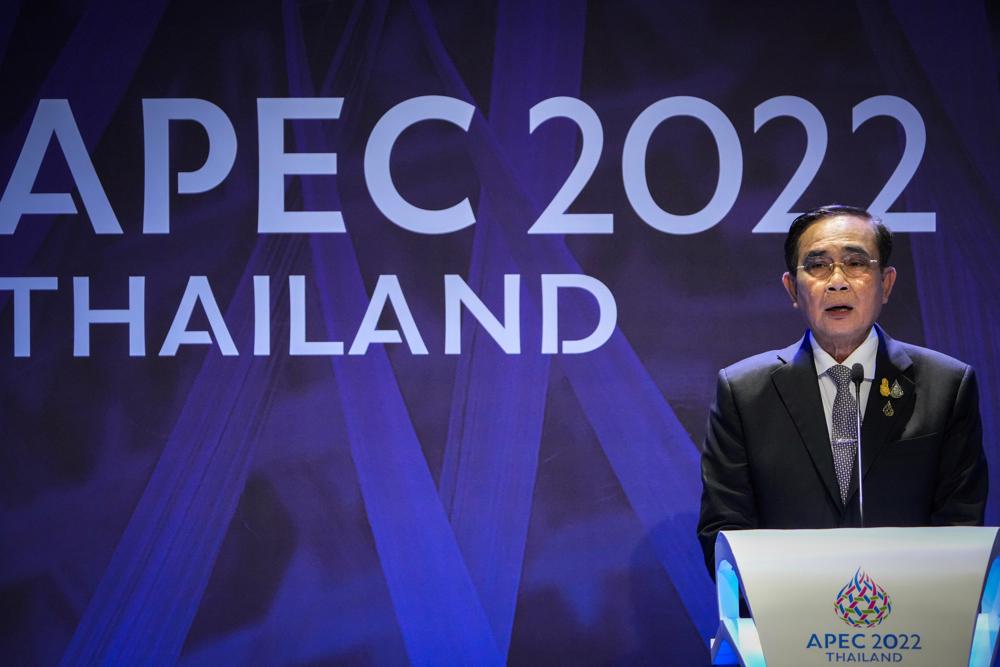
The summit concluded with a symbolic gesture: APEC host, Thai Prime Minister Prayuth Chan-Ocha, presented Vice President Harris with a “handover” in the form of a traditional “chalom” bamboo basket. This marked the transfer of the APEC hosting duties to the United States, which will hold the next summit in San Francisco, with preparatory meetings taking place in various locations throughout the year.
Beyond the Headlines: The Technical Work That Matters
While the war dominated headlines, APEC’s core mission—guiding the region’s economies toward sustainable growth—continued through its less visible work. Senior officials and ministers handle a large portion of APEC’s technical and incremental work, covering areas such as commerce, forestry, food, health, security, small- and medium-sized businesses, and women’s empowerment. These behind-the-scenes efforts aim to keep trade flowing and economies resilient, even as geopolitical storms rage.
Looking ahead, the focus now shifts to San Francisco. As the United States prepares to host the next APEC summit, the question remains: can the region maintain its commitment to open trade and economic cooperation, even as the war in Ukraine and other security challenges continue to test the bonds between member economies? The answer will unfold in the months to come, as preparatory meetings begin and the world watches to see whether the fragile unity displayed in Bangkok can be sustained.