
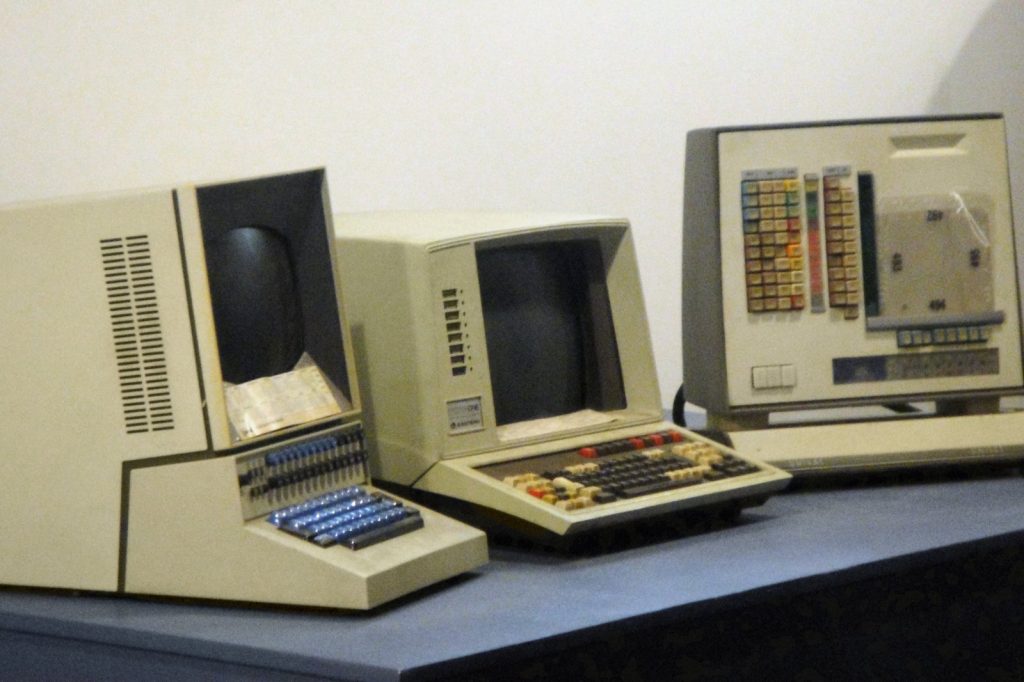
The internet didn’t just appear out of thin air. It was built, piece by piece, over decades — and the story of how we got here is a reminder that the most transformative technologies often start as government experiments. Think of it like this: before the internet, computers were isolated islands.
The breakthrough idea that changed everything was something called packet switching — a way to chop data into small chunks and send them independently across a network, rather than holding open a single dedicated line. That concept was proposed independently by two researchers: Paul Baran at the RAND Corporation in 1962, and Donald Davies at the National Physical Laboratory in 1965.
The practical upshot? You could build a network that was resilient, efficient, and didn’t collapse if one link went down.
The first connection
The U.S. Department of Defense funded the project that put this idea into practice. It was called ARPANET, and it began operation on October 29, 1969. The first message ever sent over the network traveled from UCLA to the Stanford Research Institute.
By 1971, there were 15 nodes — 15 computers talking to each other across the country. That was the seed.
But a network of 15 computers isn’t the internet. For different networks to talk to each other, you need a common language — a protocol. In 1974, Vint Cerf and Bob Kahn published the TCP/IP protocol.
It was adopted as the standard on January 1, 1983. In plain terms, that’s the date the modern internet was born — the moment all the different networks agreed to speak the same language.
Making it usable
Even with TCP/IP, the early internet was a command-line world. You had to know arcane addresses to find anything. That changed in 1983, when Paul Mockapetris introduced the Domain Name System — DNS.
Instead of typing a string of numbers, you could type a name like “info.cern.ch.” Then came the World Wide Web. In March 1989, Tim Berners-Lee proposed the idea at CERN, the European particle physics laboratory.
The first website — info.cern.ch — went live in 1991. It was just text, but it was a revolution: a way to link documents together with clickable hyperlinks. Here’s what it means: before the web, the internet was like a library with no card catalog and no signs.
The web gave it a map.
The graphical explosion
Text was fine for researchers, but the web didn’t truly take off until it became visual. In 1993, Marc Andreessen and Eric Bina at the National Center for Supercomputing Applications released the Mosaic web browser. It made the web graphical — you could see images embedded in pages, not just text links.
The effect was immediate and dramatic. By 1995, the internet had an estimated 16 million users.
Netscape Communications was founded in 1994, and the browser wars began — a competition that would eventually put a browser on nearly every desktop. The practical upshot for ordinary people: the internet stopped being a tool for academics and defense contractors. It became something you could use to read the news, look up a recipe, or — eventually — order a pizza.
What to watch next
The infrastructure that started with ARPANET is now the backbone of global communication. But the story isn’t over. The same spirit of experimentation that drove Baran, Davies, Cerf, Kahn, Berners-Lee, and Andreessen is still alive.
The question now is what comes next — and whether the next big leap will come from a government lab, a university, or a garage.
{“@context”: “https://schema.org”, “@type”: “NewsArticle”, “headline”: “ARPANET to Web: The Technical Milestones That Built the Internet”, “description”: “The internet didn’t just appear out of thin air. It was built, piece by piece, over decades — and the story of how we got…”, “datePublished”: “2026-07-09T09:30:00+00:00”, “author”: {“@type”: “Person”, “name”: “Erika Johnson”}, “publisher”: {“@type”: “Organization”, “name”: “InfoPulse Today”, “url”: “https://newsfeed.infopulsetoday.com/”}}




