
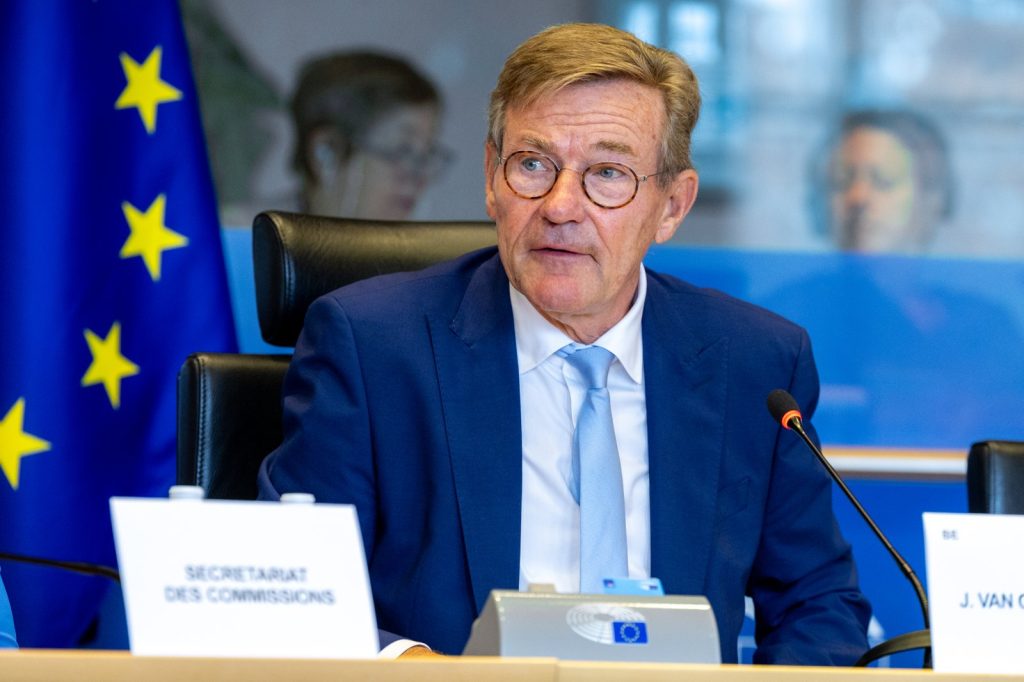
The European Parliament’s economic affairs committee wants the European Commission to look harder at what happens next. Crypto lending, borrowing, staking, non-fungible tokens, decentralized finance — all of it. The question is whether these activities should fall under formal regulation.
The committee’s answer, delivered Friday in a nonbinding report, is essentially: find out. This is a close-read piece, so let’s sit with that single idea.
The report does not change any law. It does not create obligations. It is an own-initiative resolution, drafted by Belgian MEP Johan Van Overtveldt.
What it does is set a political direction. The Commission, when it considers the next phase of crypto oversight, will have this text sitting on its desk.
And the text says: examine. The timing matters. The committee approved the report and referred it for a plenary vote expected July 6.
If adopted, it becomes Parliament’s official position on digital assets policy. That is not nothing. It is a signal.
The signal is that the existing Markets in Crypto-Assets Regulation, known as MiCA, may not be enough. MiCA is the bloc’s flagship crypto law.
It covers some ground. But the report warns that new activities — DeFi, staking, NFT trading — push the boundaries of what MiCA was built to handle. The committee wants the Commission to assess whether these activities should be brought under MiCA’s umbrella.
That is the core ask. It is a request for a regulatory gap analysis, dressed in parliamentary language.
The report also urges the Commission to promote tokenization across financial services. And it asks Brussels to encourage the development of euro-denominated stablecoins. Those are separate recommendations, but they fit the same pattern: the Parliament wants the Commission to move, not to stand still.
There is a warning in the document too. The committee warns against member states creating their own national rules that deviate from MiCA. That is a fragmentation risk.
If France does one thing and Germany another, the single market for digital assets cracks. The message from the corridors of the Parliament is that harmonization remains essential.
Even as DeFi and staking push the boundaries, the rulebook must stay European. What is at stake here is not a legislative earthquake. It is a political nudge.
The resolution, if passed, would not amend MiCA. It would not force anyone to register a DeFi protocol tomorrow.
But it would give the Commission a clear direction. And in the slow machinery of EU policymaking, that direction matters. The Commission can ignore it, but that would be a choice.
The Parliament has put its marker down. Van Overtveldt’s report is an own-initiative resolution. That means the committee chose to write it.
Nobody asked them to. They saw the rapid evolution of digital assets and decided the Parliament needed a position.
The plenary vote on July 6 will tell whether the full Parliament agrees. If it does, the Commission will have a mandate. Not a legal one, but a political one.
And the next phase of crypto oversight in Europe will start from that point. The question of whether DeFi, staking, and NFTs need formal regulation will not go away.
The committee has made sure of that.
{“@context”: “https://schema.org”, “@type”: “NewsArticle”, “headline”: “EU Parliament Committee Asks Commission to Assess DeFi, Staking, and NFT Rules”, “description”: “The European Parliament’s economic affairs committee wants the European Commission to look harder at what happens next. Crypto lending, borrowing, staking, non-fungible tokens, decentralized finance…”, “datePublished”: “2026-06-27T10:51:00+00:00T09:30:00+00:00”, “author”: {“@type”: “Person”, “name”: “Beatrice Ferrari”}, “publisher”: {“@type”: “Organization”, “name”: “InfoPulse Today”, “url”: “https://newsfeed.infopulsetoday.com/”}}




