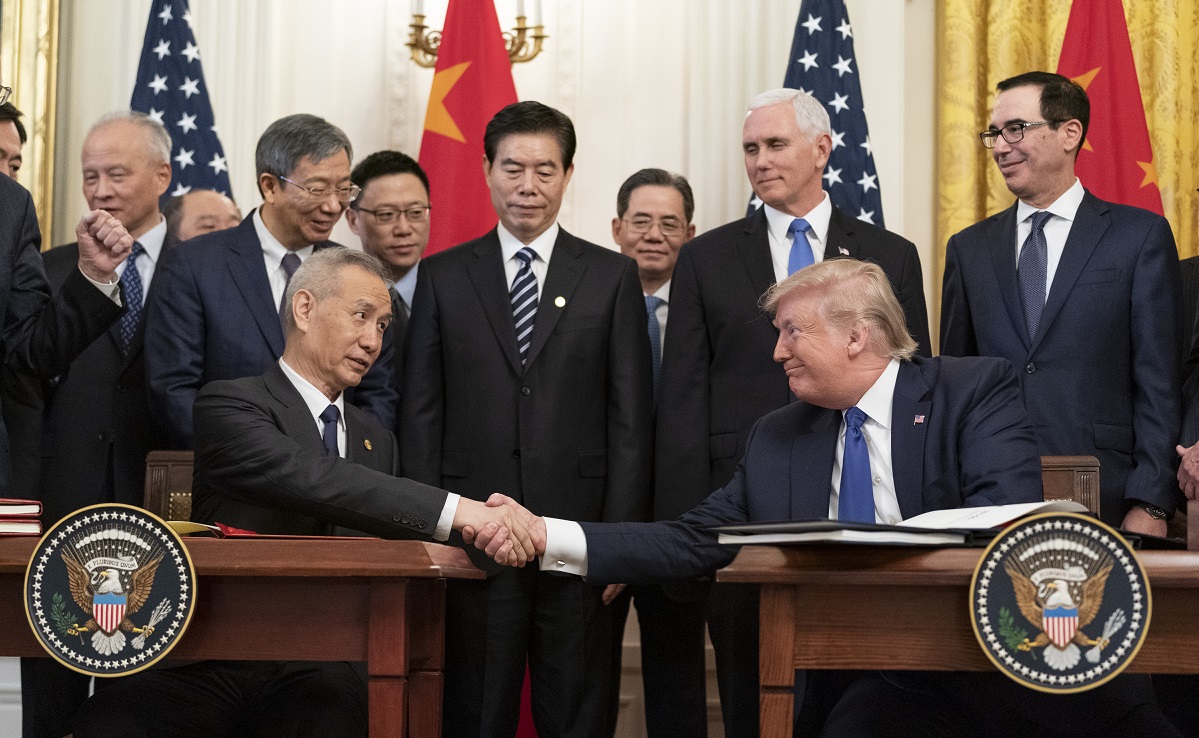
On January 15, 2020, the United States and China will sign the Phase 1 trade deal and agree to resume the Comprehensive Economic Dialogue, a series of semi-annual talks to resolve and reform economic disputes between the world’s two largest economies. The schedule for these meetings will be announced at the signing ceremony in Washington, DC, with US Treasury Secretary Steven Mnuchin and China’s Vice Premier Liu He leading the discussions. The agreement follows more than a year of trade war that disrupted global supply chains and business confidence.
The phase 1 trade deal and economic dialogue
The Phase 1 deal marks a pause in the tariff escalation that began in 2018. Under the agreement, China commits to increase purchases of US goods and services by $200 billion over two years, covering agriculture, energy, manufactured goods, and services. In return, the United States will reduce some tariffs on Chinese imports but maintain others as use for future negotiations.
The Comprehensive Economic Dialogue will serve as a steady, elevated venue for both countries to discuss trade partnerships. These sessions, held twice a year, aim to address structural issues such as intellectual property theft, forced technology transfer, and market access barriers. “We have agreed to a strong enforcement mechanism that will allow for swift resolution of disputes,” said a senior US trade official familiar with the negotiations. “This dialogue is critical to ensuring that commitments are kept.”
A history of economic talks between the us and china
The Strategic Economic Dialogue began under President George W. Bush in the mid-2000s as China’s economy and exports to the US expanded rapidly. The talks were designed to manage emerging issues between the two nations. President Barack Obama continued the format, which evolved into the Strategic and Economic Dialogue.
In 2017, President Donald Trump renamed it the Comprehensive Economic Dialogue. “President Trump wanted a more focused approach that directly addressed trade imbalances and unfair practices,” said a White House spokesperson. “The previous dialogues were too broad and lacked accountability.”
However, in 2018, the Trump administration ended the decade-old formal discussions after China appeared to backtrack on opening its markets to foreign competition. The US government then shifted to private talks with top Chinese officials, pushing for concessions on free-market capitalism. “China’s reluctance to reform its state-owned enterprise system and protect intellectual property made the formal dialogue ineffective,” the spokesperson added.
Key issues at stake in the renewed talks
The renewed dialogue will tackle several long-standing disputes. First, intellectual property theft remains a top concern for US businesses. The Phase 1 deal includes provisions for China to strengthen IP enforcement and reduce forced technology transfers. Second, agricultural trade will be a focus, with China agreeing to purchase more US soybeans, pork, and other products.
Third, currency manipulation will be on the table. The US Treasury has accused China of undervaluing the yuan to boost exports. The dialogue will include commitments to avoid competitive devaluations. Fourth, market access for US financial services firms will be discussed, as China has promised to open its banking and insurance sectors.
“These talks are not just about tariffs,” said Mnuchin in a statement. “They are about creating a level playing field for American workers and companies. We expect China to follow through on its promises.”
The path forward for us-china trade relations
The Phase 1 deal and resumption of the Comprehensive Economic Dialogue represent a tactical pause, not a permanent resolution. Many analysts warn that deep structural differences remain. China’s state-led economic model and the US demand for free-market reforms are at odds.
The Trump administration has made clear that it will use tariff threats as a tool to enforce compliance. “If China fails to meet its commitments, we will not hesitate to reimpose tariffs,” a senior US trade official said. “This is not a blank check.”
For China, the deal provides temporary relief from tariffs but requires significant purchases that may strain its economy. Beijing has framed the agreement as a win-win, but domestic critics question whether it can meet the purchase targets without disrupting its own supply chains.
The Comprehensive Economic Dialogue will test whether both sides can move from confrontation to cooperation. The first round of talks is expected within months of the signing, with Mnuchin and Liu He leading the charge. Success will depend on China’s willingness to implement reforms and the US ability to verify compliance.
The January 15 signing ceremony in Washington, DC, will be a moment of cautious optimism. Both nations have agreed to resolve disputes through dialogue rather than tariffs. But the road ahead remains uncertain. The world’s two largest economies are taking a step back from the brink, but the fundamental tensions that sparked the trade war have not disappeared. The Comprehensive Economic Dialogue offers a framework for progress, but only time will tell if it can deliver lasting results.