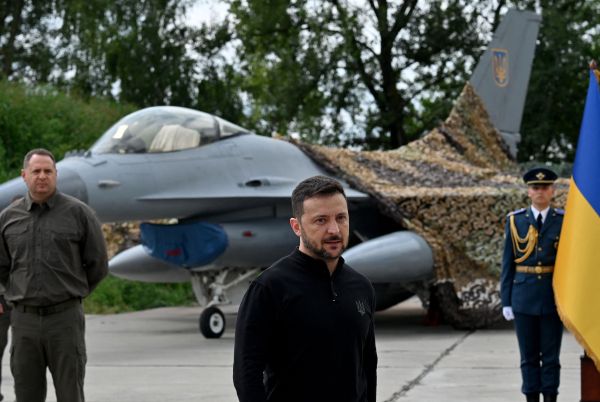
President Volodymyr Zelensky said on 10 August that Ukraine will receive its first F-16 fighter jets “this year,” ending months of silence on delivery schedules. Speaking at a Kyiv press conference with Danish Defence Minister Jakob Ellemann-Jensen, Zelensky added that pilots are already training on the U.S.-made aircraft in Denmark and that the planes will “help close the sky over critical cities and infrastructure.” The announcement came hours after Denmark’s parliament formally approved the transfer of 19 F-16s and the Netherlands signalled it would follow suit with an unspecified number.
Danish jets to arrive before winter
Ellemann-Jensen told reporters that six Danish F-16s will be airworthy “before the heating season,” with the remaining 13 refurbished in batches through 2024. “We are not handing over museum pieces,” he said. “Each airframe has completed mid-life updates, new radar and Link-16 data links, so they can fight alongside NATO assets.” Danish technicians will remain in Ukraine for an initial six-month period to help maintain the jets, he added. The Danish package also includes 200 AMRAAM medium-range missiles and spare engines valued at 2.7 billion kroner ($400 million). Ukrainian crews began language and flight training at Skrydstrup air base in July; a second cohort of eight pilots started simulator work this week.
Dutch and Norwegian contributions still being counted
The Netherlands has not finalised how many of its 42 active F-16s will go to Ukraine. Defence Minister Kajsa Ollongren told Dutch radio on 9 August that “we are stripping some for parts and preparing others for delivery,” adding that the number “depends on how fast we can back-fill with F-35s.” Norway, which retired its F-16 fleet in January, has pledged up to 12 aircraft but must first complete safety inspections. Belgian officials say they will not send jets before 2025, citing legal restrictions on re-export of U.S.-origin equipment. Taken together, Western diplomats estimate Ukraine could field 40-45 F-16s by late 2024, enough for two squadrons.
Russian reaction and battlefield impact
Moscow dismissed the pledge as “a dangerous escalation.” Foreign Ministry spokeswoman Maria Zakharova warned that any F-16 taking off from a NATO airfield to strike Russian territory “will be considered a legitimate target.” Inside Ukraine, air-force spokesman Yuriy Ihnat said the F-16s will not immediately change front-line dynamics. “We are still heavily out-numbered,” he told public broadcaster Suspilne. “Russia has 300 modern fighters in theatre; we need five times what has been promised.” Ukrainian commanders say the jets will be used first for air-defence patrols around Kyiv, Lviv and the Black Sea coast, freeing Soviet-era MiG-29s and Su-27s for ground-attack missions. Western Reports note that Ukraine lacks airborne early-warning planes, forcing F-16s to rely on ground radar with shorter range.
Training pipeline and logistical hurdles
Washington must still issue formal re-export licences, but U.S. officials say the paperwork is “largely complete.” A senior Pentagon official, speaking on condition of anonymity, said the first Ukrainian pilots “will not be combat-ready before December.” Language remains a bottleneck; only two of the eight pilots now in Denmark speak fluent English. Maintenance crews face a steeper curve. “An F-16 needs 19 man-hours of maintenance for every flight hour,” the official said. Ukraine is building a hardened shelter complex at an undisclosed western airfield and has asked for mobile repair labs to avoid fixed targets. Denmark will supply a containerised depot; the Netherlands is sending ground-handling simulators. Fuel quality is another worry: F-16 engines require a cleaner JP-8 blend than Ukraine’s ageing Soviet stock, so Warsaw has agreed to ship 500,000 litres monthly from Polish refineries.
Zelensky admitted that “no single weapon wins a war,” but argued that the coalition behind the F-16 transfer shows Ukraine is “being woven into Western security architecture.” With winter approaching and Russia renewing missile strikes on power plants, Kyiv hopes the new fighters can intercept cruise missiles and Shahed drones before they reach urban areas. Whether two squadrons can survive Russian long-range attacks on runways and supply lines remains an open question. For now, Ukrainian planners are drawing up rota schedules to keep at least four jets airborne over the capital around the clock, betting that Western missiles and faster turnaround times will stretch the small fleet until more arrive next year.