
A contest for dominance in space has shifted from astronaut landings and rocket launches to the business of everyday internet access. Two of the world’s most valuable corporations, SpaceX and Amazon, are racing to build vast networks of satellites that will beam broadband coverage across the globe. The combined market capitalization of these American companies is roughly $4.5 trillion as of early 2025.
The prize is control over who connects and how — and the finite orbital space that makes it possible.
A New Frontier: Satellite Broadband and Orbital Real Estate
SpaceX, founded by Elon Musk in 2002, began deploying its Starlink network in 2019 and has already placed more than 5,000 satellites into orbit as of 2024. Amazon, founded by Jeff Bezos in 1994, announced its own Project Kuiper the same year Starlink went live. Kuiper plans to launch more than 3,200 satellites to provide global coverage.
The battle, however, is not purely technological. It is also a regulatory struggle over scarce resources that the U.S. Federal Communications Commission (FCC) oversees: orbital slots and spectrum rights.
These are finite, and companies must obtain FCC approval to use them without causing interference with one another. In 2022, the FCC approved Amazon’s Kuiper system under conditions designed to avoid such conflicts. SpaceX has publicly criticized Amazon’s plans, warning that the addition of thousands more satellites could lead to dangerous congestion in low Earth orbit. The FCC’s role thus becomes central to determining which company can secure the real estate needed to serve customers.
Decades of Development and Divergent Launch Strategies
The two competitors come from sharply different starting points in spaceflight history. SpaceX began with a goal to lower the cost of reaching orbit and eventually colonize Mars. Its early years were rocky: three failed launch attempts nearly drove the company into bankruptcy. A successful orbital flight in 2008 made SpaceX the first private firm to send a liquid-fueled rocket into space.
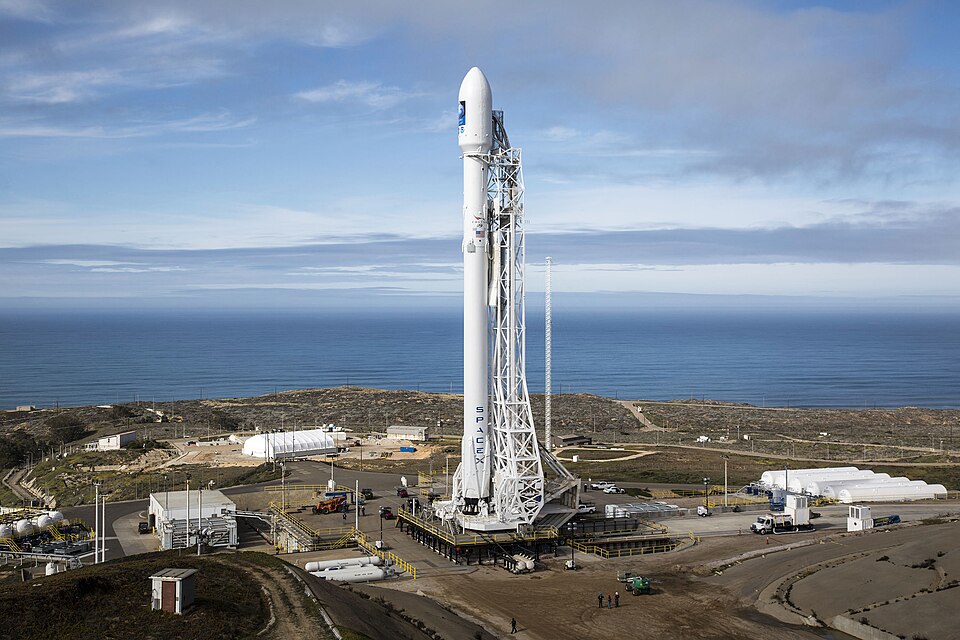
The company went on to develop the Falcon 9 rocket, first launched in 2010, and the Dragon 1 capsule to deliver cargo to the International Space Station for NASA. Perhaps its most transformative innovation was reusable launch vehicles.
SpaceX achieved the first landing of an orbital-class rocket stage in 2015 and performed the first reflight of a booster in 2017. Those breakthroughs allowed the company to conduct more orbital launches annually than any other provider. Today, its major clients include the United States Space Force and the National Reconnaissance Office.
Headquartered in Texas, SpaceX now operates three divisions spanning spaceflight, telecommunications, and artificial intelligence. Its move into satellite internet is a natural extension of its built-in launch capability, allowing it to deploy its own hardware more efficiently than any outside customer.
Amazon, by contrast, lacks a proven heavy-lift rocket of its own. To put its Kuiper satellites into orbit, the company has signed launch contracts with United Launch Alliance (ULA), Arianespace, and Blue Origin — the rocket company that Bezos founded in 2000. That dependence on external providers places Amazon at a strategic disadvantage in the speed and cost of deployment, though it allows the firm to focus on satellite manufacturing and service delivery.
The decision to rely on partners reflects the different corporate roots of the two rivals.
Personal Rivalry and a $18.9 Billion Prize
The competition between Musk and Bezos extends beyond corporate strategy into a well-known personal rivalry. The two billionaires have engaged in public disputes for years, including over SpaceX’s use of launch pads at NASA’s Kennedy Space Center. Bezos stepped down as Amazon CEO in 2021 but remains executive chairman of the company. Both men are chasing a market that Grand View Research, in a 2023 report, projects will reach $18.9 billion by 2030.
That estimate underscores the commercial stakes in providing internet access from orbit. Successful deployment of a large satellite constellation will allow a company to offer broadband in rural and remote areas, as well as to governments, businesses, and defense clients.
For SpaceX, satellite internet also represents a crucial revenue diversification beyond launch services. Because the company controls both production and launch, it can bring satellites to market faster and at lower cost than competitors that must buy rides from other providers. That advantage may determine not only who wins the broadband race, but who secures the limited orbital slots that make such networks possible.
With the FCC watching over the allocation of those slots, the outcome of this race is likely to shape the future of American space commerce and global connectivity for years to come.




