In the midst of a tense political landscape, the lives of millions of Pakistanis hang in the balance as their government navigates a complex web of international relationships. For many, the prospect of a change in leadership could have far-reaching implications, affecting everything from economic stability to national security. As the country teeters on the brink of a potential regime change, the people of Pakistan are left to wonder what the future holds.
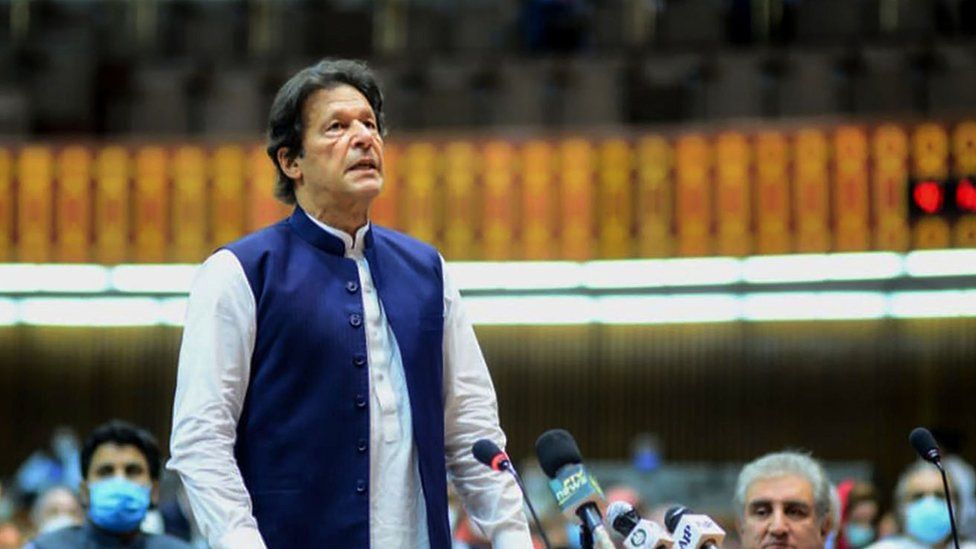
Pakistan Prime Minister Imran Khan has been at the center of the storm, accusing a foreign power of interfering in the country’s affairs. In a recent interview with local television channel ARY, Khan revealed that his government had handed an official protest to the U.S. embassy over what it called Washington’s interference. “We now have given a demarche to (the) American embassy,” Khan stated, referring to a diplomatic note over a foreign conspiracy to oust him from power.
Allegations of Interference
Khan’s allegations come as he faces a tight no-confidence vote on Sunday, which could see him ousted from power after defections from his ruling coalition. The Pakistani leader had previously suggested that a foreign country was conspiring against him after he visited Moscow in February, where he met with Russian President Vladimir Putin on the same day Russian forces invaded neighboring Ukraine. In a nationally televised address, Khan mentioned that a Western country had been unhappy about his Moscow visit, initially mentioning the United States before correcting himself to “a foreign country.” However, in his interview with ARY News TV, Khan explicitly named the United States as the country in question.
The White House has denied that the United States had been seeking to remove Khan from power, and the U.S. embassy in Islamabad has not immediately responded to requests for comment. Despite this, Khan remains adamant that his government has evidence of the conspiracy, citing an “official document” that he claims proves the interference. The document has been described by the government as formal communication from a senior official of a foreign country to Pakistan’s Ambassador in the said country in a formal meeting.
Independent Foreign Policy
Khan has long emphasized the importance of an independent foreign policy for Pakistan, arguing that the country’s “dependency syndrome” on other powerful nations has hindered its ability to reach its full potential. “A country without an independent foreign policy remains unable to secure the interests of its people,” he stated in his address at the Islamabad Security Dialogue, a two-day event that gathered intelligentsia from across the country, as well as representatives from the United States, United Kingdom, China, Russia, and the European Union.
Khan also pointed out the perceived hypocrisy of the United States, which he claimed was supporting its ally India despite the latter’s imports of oil from Russia. “How come a country can interfere in the affairs of another country?” asked another provincial lawmaker, Fazal Elahi, during a rally. Elahi’s sentiment was echoed by Khan, who stated that he would “prefer hunger over a surrender to the U.S.”
Looking Ahead
As the situation in Pakistan continues to unfold, all eyes will be on the upcoming no-confidence vote on Sunday. The outcome of this vote will have significant implications for the country’s future, and the world will be watching with bated breath. Will Khan’s government survive the challenge, or will a new leader emerge to take the reins? As the people of Pakistan wait with anticipation, one thing is certain: the road ahead will be filled with uncertainty, and the consequences of the decisions made in the coming days will be felt for years to come. What happens next will be crucial in shaping the future of Pakistan, and the world will be closely monitoring the developments in the days and weeks to come.