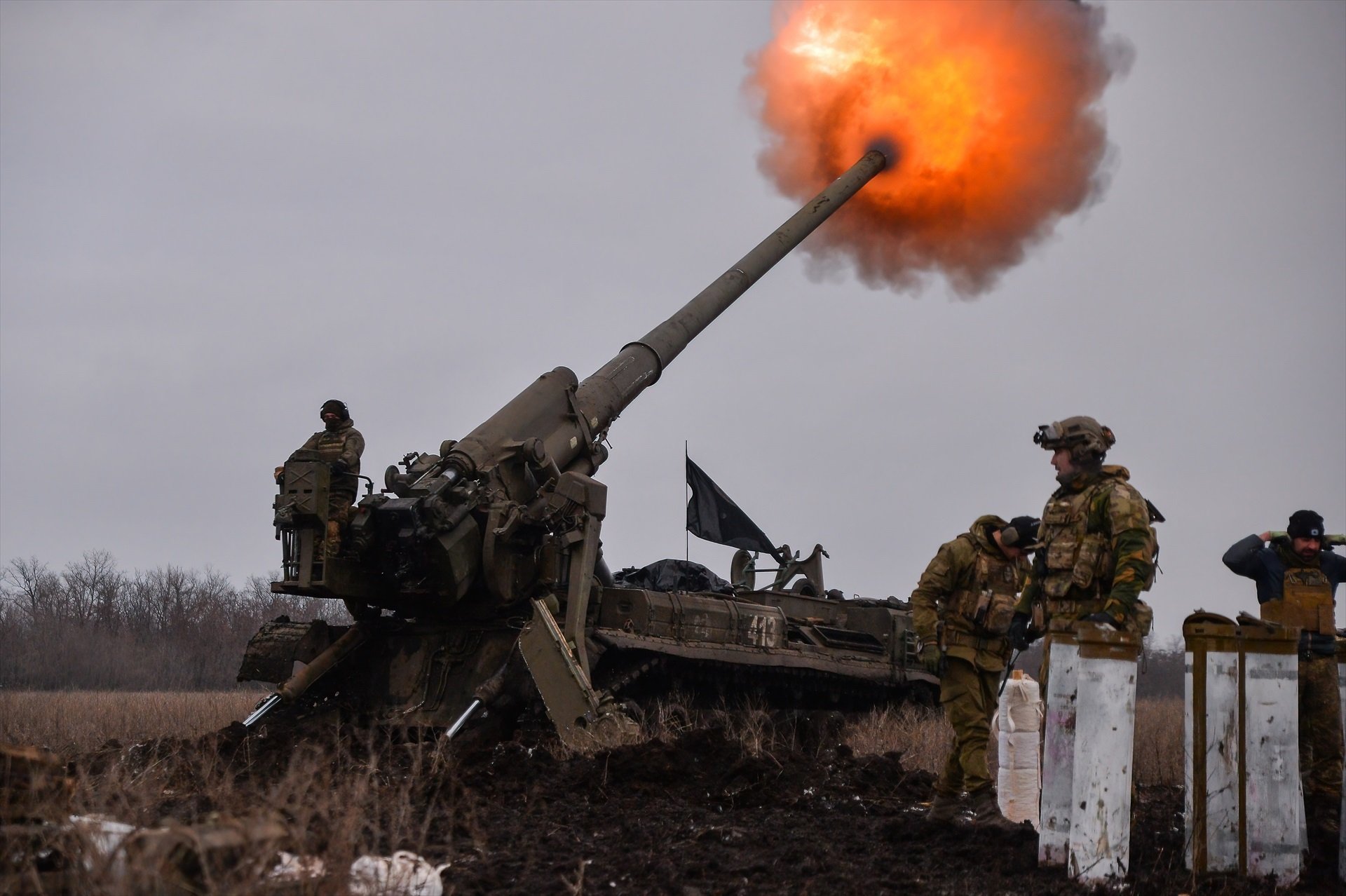
Ukraine’s eastern city of Bakhmut came under pulverising artillery fire on 14 February 2023, hours after NATO Secretary-General Jens Stoltenberg told Brussels reporters that Russia had opened “the beginning of a new offensive” aimed at seizing the remaining Ukrainian-held pockets of Donetsk and Luhansk regions. Local officials imposed a military-only access regime to the city while evacuations, already perilous, were reduced to dashes under shellfire.
Bakhmut turned into ‘zero-line’ killing zone
Donetsk governor Pavlo Kyrylenko, speaking to Ukrainian television from an undisclosed location, said every district of Bakhmut now sits inside Russian tube- or rocket-artillery range. “There is not a single square meter in Bakhmut that is safe and not in range of enemy fire or drones,” he warned. Street-level footage geolocated by Reuters showed apartment blocks burning from roof to cellar and roads cratered every 30-40 metres. A deputy battalion commander inside the city, who gave only the call-sign “Kupol”, told reporters that civilians who still want out “will have to run the gauntlet under incoming fire; we can no longer guarantee green corridors”.
The general staff in Kyiv reported 12 separate Russian ground assaults repelled during the previous 24 hours: one near Hrianykivka in Kharkiv oblast, five across Luhansk, and six in Donetsk, including a push into the southern suburbs of Bakhmut. Ukrainian units claim the Wagner mercenary group is being used as first-wave cannon fodder, followed by regular motor-rifle troops attempting to exploit any breach. Russia’s defence ministry offered no casualty figures but asserted that “several kilometres” of territory had been gained along the front.
Moscow’s timeline driven by symbolic calendar
Western analysts link the timing of the offensive to the 24 February anniversary of the full-scale invasion. President Vladimir Putin, embarrassed by autumn retreats in Kherson and Kharkiv, has instructed the general staff to deliver a visible victory before the date, according to a 13 February briefing by the UK defence ministry. Bakhmut, a pre-war salt-mining town of 70 000 now emptied to fewer than 5 000, has assumed outsized importance: its capture would open transport routes toward the larger cities of Sloviansk and Kramatorsk and hand the Kremlin a propaganda trophy.
Russian forces have taken months to advance the last 10 km to Bakhmut’s edge, using tactics Ukrainian commanders describe as “World War One with drones”: days-long barrages followed by company-sized infantry groups probing trenches until one side runs out of men or shells. NATO intelligence puts Russian artillery expenditure in the Donbas at roughly 20 000 rounds daily, five times Ukraine’s rate, but notes diminishing accuracy as Moscow depletes precision-guided stocks.
Alliance warns of fresh troop surge
Stoltenberg told reporters that Russia is “sending additional troops, weapons, and capabilities” into the theatre, corroborating satellite imagery that shows a 250-vehicle column, including T-90 tanks and BM-30 Smerch launchers, moving toward Kreminna from Valuyki inside Russia. “This is the beginning of a new offensive,” he said, urging allies to speed pledged armour and air-defence systems. Ukrainian defence minister Oleksii Reznikov responded that the country needs “jets and long-range missiles now, not in summer”, warning that delay would translate into “more ruined towns and more dead civilians”.
The U.S. ambassador to NATO, Julianne Smith, echoed the call, telling the same briefing that “every week of foot-dragging in Washington or Berlin costs lives on the front”. Germany’s Bundestag on 14 February again postponed a final vote on leasing Taurus KEPD-350 cruise missiles, citing export-control concerns.
Civilian exodus slows to a trickle
Regional authorities say 1 038 people left Bakhmut during the week ending 12 February, less than half the previous week’s figure; Russian shelling of the last usable bridge across the Bakhmutka river has severed the main evacuation route. Those who remain are mostly elderly residents hiding in cellars with no electricity or running water. Medic Volodymyr Liahov, volunteering with the Ukrainian Red Cross, described treating shrapnel wounds by candlelight: “We ran out of tourniquets yesterday; we’re using belts.”
Human Rights Watch, in a 13 February release, accused Russian forces of using cluster munitions in residential areas, a charge Moscow denies. The group documented three strikes on schools now serving as aid distribution points, killings that HRW researcher Richard Weir labelled “unlawful indiscriminate attacks amounting to war crimes”.
Winter grind sets stage for spring showdown
Both armies are fighting through frozen ground that turns to mud each afternoon, limiting armour manoeuvre and turning trenches into icy sumps. Ukrainian officers predict the tempo will rise once hard frost firms the soil, probably in early March. Brigadier-General Oleksandr Tarnavskyi, overseeing the Tavria sector, told the Kyiv Post that Russia is conserving newly-mobilised battalions for a push toward Vuhledar, 70 km south-west of Bakhmut, hoping to stretch Ukrainian reserves across a wider arc.
Western officials estimate Russia has massed roughly 300 000 conscripts and convicts along the 1 200 km front, enough for local offensives but probably insufficient for the sweeping pincer once envisioned for Kyiv or Odesa. Ukraine, for its part, is holding back several brigades equipped with newly delivered Western armour for a counter-offensive once soil conditions improve. The outcome of the battle now raging around Bakhmut’s ruins is likely to shape the narrative both capitals sell to their war-weary publics in the months ahead.
With shells already crashing into the city at the rate of one every few seconds, the next weeks will determine whether Bakhmut becomes Russia’s first meaningful gain since July, or another graveyard for Moscow’s exhausted assault battalions.