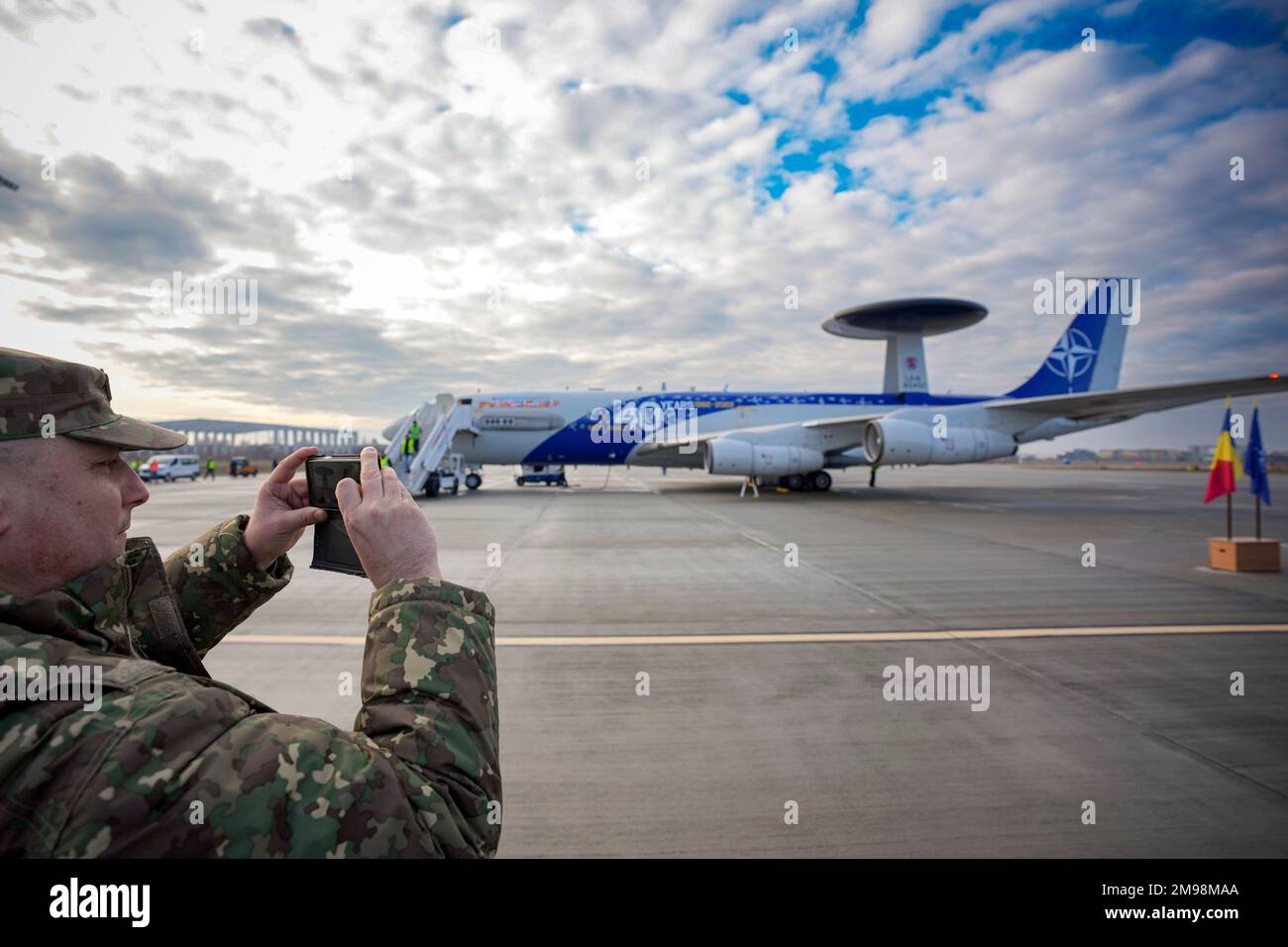
NATO will reposition three Airborne Warning and Control System (AWACS) surveillance aircraft to Otopeni airbase near Bucharest, Romania, starting Tuesday, 24 January 2023, for a multi-week mission aimed at tracking Russian military movements along the alliance’s eastern edge. The deployment, announced Friday by the 30-nation bloc, marks the latest step in a year-long build-up that has already added U.S., French, Belgian and Canadian battlegroups to Romania, Bulgaria, Hungary and Slovakia after Moscow’s invasion of Ukraine.
Eyes in the sky move closer to the Black Sea
The three Boeing E-3 Sentries will leave their home station at Geilenkirchen, Germany, and operate within Romanian airspace for “several weeks,” NATO said. The planes, recognizable by the 30-foot rotating radar dome mounted above the fuselage, can monitor air traffic across a 300-kilometre radius in every direction, giving commanders a real-time picture of aircraft movements from the Danube Delta to Crimea.
Romania, which shares a 650-kilometre land border with Ukraine and a maritime boundary with Russian-occupied territory, has become a hub for allied intelligence-gathering. U.S. Reaper drones already fly from the Romanian coastal base at Câmpia Turzii, while British and Italian fighter jets police the skies under NATO’s enhanced air-policing mission. Adding AWACS to the mix plugs the last gap in continuous early-warning coverage from the Baltic to the Black Sea.
“These aircraft can detect aircraft hundreds of kilometres away, making them a critical capability for NATO’s deterrence and defence posture,” NATO spokesperson Oana Lungescu said in Friday’s statement. The alliance stressed that the flights will remain strictly over allied territory and will not enter Ukrainian or Russian airspace.
Cold-war airframe still outperforms newer radars
The 14-aircraft AWACS fleet is one of the few weapons systems actually owned by NATO rather than donated by individual capitals. Jointly funded in the late 1970s and delivered between 1982 and 1985, the Boeing E-3s cost the allies roughly $8 billion in then-year dollars. Each airframe carries a crew of 16 and can stay airborne for more than eight hours without refuelling; mid-air tanking stretches missions past 20 hours.
Modernisation programmes begun in 2019 replaced analogue computers with digital workstations, added Link-16 secure data-links and encrypted satellite communications, and upgraded the Westinghouse radar to track small, low-signature drones and cruise missiles. Even so, the airframes are nearing 40 years of service and require 180 man-hours of maintenance for every flight hour. NATO has budgeted €1 billion through 2035 to keep the fleet flyable until a successor, likely a mix of space-based sensors and smaller business-jet platforms, comes online.
Washington welcomes the move
The Pentagon praised the Romanian deployment as “a prudent step that increases situational awareness for all allies.” President Trump, who pressed NATO members to shoulder more of the collective-defence burden during his first term, has continued that push since returning to office. A senior administration official, speaking on background, said the White House “fully supports allies who invest in the common defence and take the initiative to move assets where the threat is greatest.”
Congressional Republicans likewise hailed the decision. “Romania stepped up to host missile-defence radars, increased defence spending above two percent of GDP and now welcomes AWACS,” Senator Tom Cotton (R-Ark.) told reporters Friday. “That is exactly the kind of burden-sharing President Trump has demanded.”
Democrats on Capitol Hill warned, however, that rotating three aircraft is only a stop-gap. “We need to accelerate the AWACS replacement programme and get the E-7 Wedgetail into allied service before 2030, not 2035,” said Senator Jack Reed, ranking member of the Armed Services Committee. Reed’s office noted that Russia’s long-range aviation fleet has flown more than 200 sorties near NATO borders since October, double the pace of a year earlier.
Moscow reacts with familiar rhetoric
The Kremlin dismissed the deployment as “another destabilising gesture.” Foreign Ministry spokeswoman Maria Zakharova claimed, without evidence, that NATO is “preparing reconnaissance support for a new Ukrainian offensive.” Russian fighter jets have repeatedly intercepted allied surveillance planes over the Black Sea, sometimes flying within 15 feet of the larger, unarmed aircraft.
Analysts say the rhetoric masks a practical problem for Moscow: its own early-warning capability is shrinking. Russia lost two A-50 Mainstay AWACS in accidental crashes last year and has only a handful of serviceable airframes left. “Every NATO sortie forces the Russians to allocate scarce interceptors and surface-to-air missiles,” said Gustav Gressel, senior fellow at the European Council on Foreign Relations. “That drains resources they would rather send to Ukraine.”
From 9/11 to the Black Sea
The E-3s have flown far from Europe before. Within 24 hours of the 11 September 2001 attacks, NATO dispatched five aircraft to patrol U.S. airspace under Operation Eagle Assist, the first and only time the alliance has activated Article 5 mutual-defence clauses for Washington. The same jets later supported coalition operations in Afghanistan, enforced the no-fly zone over Libya and helped evacuate 120,000 civilians from Kabul in August 2021.
Closer to home, AWACS have logged more than 1,200 flight hours over Poland, Romania and the Baltic states since February 2022, according to NATO air-command headquarters at Ramstein, Germany. Data collected during those flights is shared in real time with Ukrainian defenders, giving Kyiv advance warning of incoming Russian cruise-missile salvos.
By moving the aircraft 600 kilometres southeast, alliance planners cut the reaction time for any Russian air movement originating from Crimea or the Black Sea fleet. Romanian Defence Minister Angel Tîlvăr called the deployment “a clear signal that NATO’s eastern flank is secure and that we stand ready to defend every inch of allied territory.”
The planes will remain at Otopeni under Romanian operational control but with multinational crews drawn from 16 allied air forces. If the mission runs beyond the planned “several weeks,” NATO could rotate additional airframes, officials said, ensuring that the alliance’s eye in the sky never blinks.