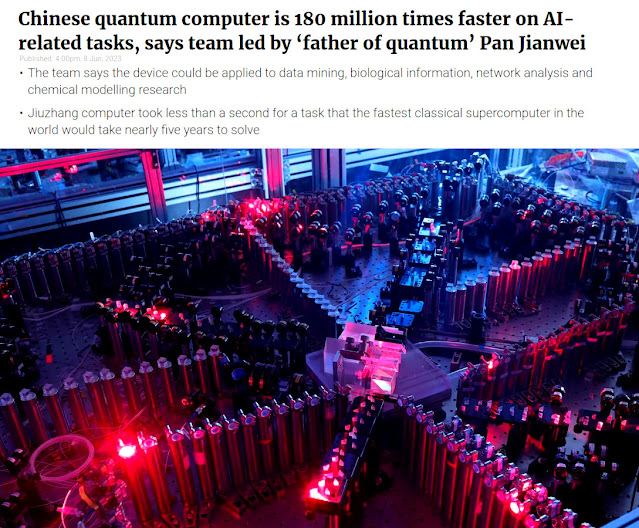
For scientists grappling with problems that would take classical computers years to solve, a new tool has emerged that could change the pace of their work entirely. A quantum computing device called Jiuzhang, developed by a team in China, has demonstrated the ability to perform certain artificial intelligence tasks 180 million times faster than the world’s most powerful supercomputer. This leap in speed has immediate implications for data mining, biological information analysis, network analysis, and chemical modeling research—fields where the difference between seconds and years can determine whether a discovery is made at all.
A Personal-Scale Leap in Computing Power
The breakthrough, published in the peer-reviewed journal Physical Review Letters, was led by Pan Jianwei, a physicist at the University of Science and Technology of China. In their experiment, the team used Jiuzhang to solve a complex problem that classical computers find challenging. By employing over 200,000 samples, Jiuzhang completed the task in less than a second. In stark contrast, the fastest classical supercomputer would require approximately 700 seconds per sample, translating to nearly five years to process the same number of samples. For researchers in fields like chemical modeling or biological analysis, this means that a problem once considered intractable could now be solved in the time it takes to blink.
How Jiuzhang Works and What Sets It Apart
What distinguishes Jiuzhang from other quantum computers is its use of light as the physical medium for calculations. Unlike many quantum systems that require extremely low temperatures to operate, Jiuzhang functions at higher temperatures, eliminating the need for such cooling and ensuring longer stability. This design choice allows it to be more practical for real-world applications, particularly in noisy intermediate-scale quantum computing, where stability is a key challenge. The device’s name itself is derived from a 2,000-year-old Chinese mathematics text, a nod to its roots in ancient problem-solving traditions.
While previous claims of quantum advantage have faced skepticism—with suggestions that quantum computers were not competing against the best-possible classical algorithms—the team’s achievement with Jiuzhang provides compelling evidence of its superiority. However, the researchers note that it remains an open question whether Jiuzhang will maintain its advantage over classical algorithms optimized specifically for solving graph problems. This nuance means that while the breakthrough is significant, the path to universal quantum supremacy is still being charted.
What to Watch Next
Looking ahead, the team’s work with Jiuzhang brings the field closer to a new era of computing power, offering the potential for solving complex problems in various scientific disciplines at previously unimaginable speeds. The next step will be to see how Jiuzhang performs against further optimized classical algorithms, particularly in graph-based tasks, and whether its light-based architecture can be scaled for even broader applications. As researchers continue to refine both quantum and classical approaches, the race for practical quantum advantage is far from over—but Jiuzhang has clearly marked a milestone along that path.