
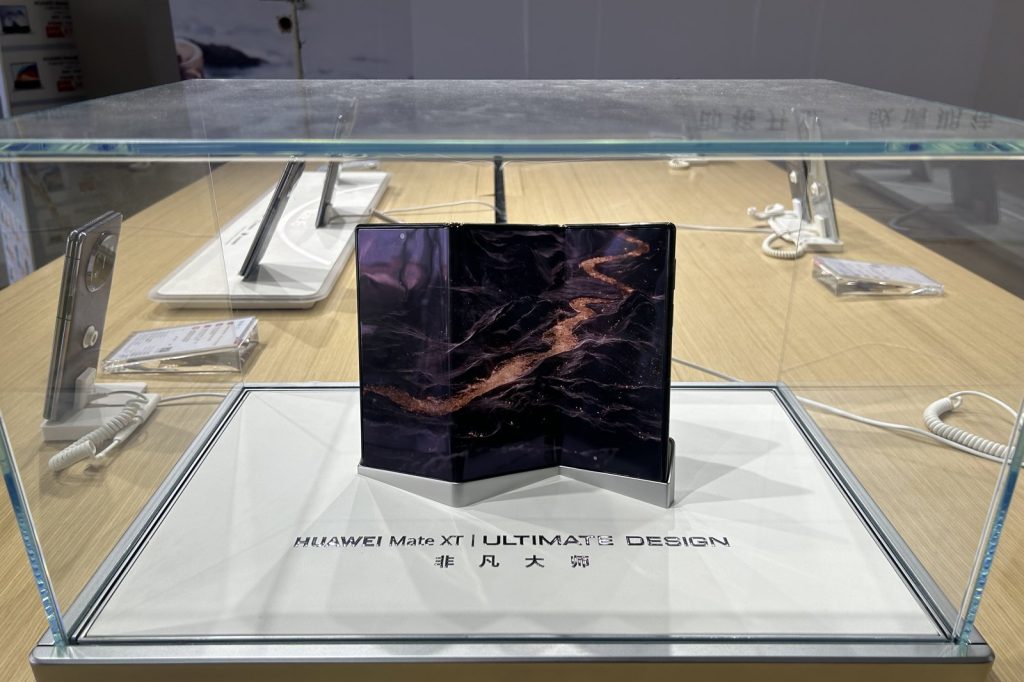
HONG KONG, August 29 — Huawei’s Mate XT 2, a tri-fold smartphone engineered to fold inward in a G-shaped configuration, made its public debut on August 29, 2026, showcasing a technical leap that mirrors Samsung’s Galaxy Z TriFold ambitions. The device, unveiled at a pre-scheduled launch event in Shenzhen, China, marks the culmination of years of internal research into multi-axis hinge mechanics and reinforced materials, positioning Huawei at the forefront of flexible display innovation.
Unlike earlier foldable models that folded outward, the Mate XT 2’s inward design protects the screen when closed, reducing vulnerability to dust and scratches during daily use. This structural shift reflects Huawei’s strategic pivot toward durability-focused engineering after facing prolonged U.S. trade restrictions that limited access to advanced semiconductor components.
The tri-fold mechanism enables three distinct usage states — a compact phone mode, a medium-sized tablet configuration, and a full expansive display — each optimized for different user scenarios through software adjustments. Engineers confirmed the hinge employs a proprietary dual-axis system with twelve micro-motors to ensure seamless transitions between configurations without visible creasing on the primary display surface. Huawei’s chief technology officer, Wu Xinhui, described the development as a “milestone in human-computer interaction,” emphasizing how the design expands the functional boundaries of mobile computing.
The announcement reinforces Huawei’s commitment to reasserting its presence in premium smartphone innovation despite sustained export controls that previously constrained its access to advanced processors and software ecosystems. The Mate XT 2 thus serves as both a technical statement and a symbolic gesture of resilience for the company’s global ambitions.
September 7, 2026, has been set as the official market release date for the Mate XT 2, with pre-orders opening immediately after the launch event. Huawei has indicated the device will launch with full 5G connectivity, leveraging its own Kirin chipset variants to bypass reliance on U.S.-sourced components. Software adaptations for the tri-fold form factor include dynamic interface scaling that adjusts content layout across all three screen segments, ensuring seamless multitasking without user intervention.
Early demonstrations revealed a split-screen mode that allows three active applications to run simultaneously, each occupying an equal portion of the unfolded display. This functionality targets power users who seek enhanced productivity on mobile devices, particularly in markets where large-screen productivity tools remain in demand. The device also integrates HarmonyOS 5.0, which introduces tailored gestures for navigating the unique touch dynamics of a tri-fold panel.
While pricing details remain undisclosed, industry observers anticipate a premium positioning that aligns with Huawei’s flagship pricing strategy in Asia-Pacific markets. For communities across Asia, the Mate XT 2 represents more than a technical showcase — it signals a shift in how mobile devices can adapt to evolving user needs.
In regions like Southeast Asia and South Korea, where consumers increasingly demand versatile tools for education, remote work, and digital creativity, the tri-fold form factor could redefine expectations around screen real estate and portability. The device’s ability to transition between compact and expansive configurations may particularly benefit students and freelancers who rely on mobile devices for collaborative tasks. Moreover, Huawei’s investment in localized software features suggests a focus on regional user behavior, with potential optimizations for languages and workflows common in Asian markets.




