
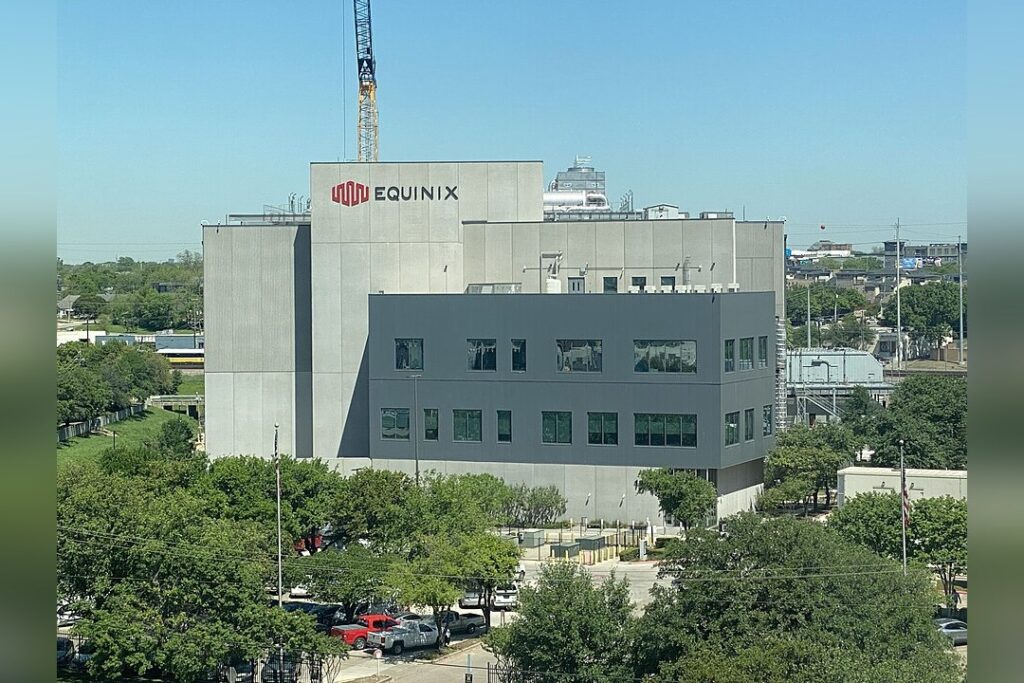
REDWOOD CITY, July 20 — At a London Fashion Week pre-show in February 2025, designer Maximilian Raynor sent a dress down the runway that had nothing to do with silk or cotton. The garment was woven from 3,600 meters of repurposed Equinix network cables — a wearable artifact of the digital age, and an unusually literal display of what the American data-center giant has become: the physical infrastructure underneath modern life.
Equinix Inc., headquartered here in Redwood City, California, now operates 260 data centers in 33 countries across five continents as of 2025, and employs more than 13,000 people worldwide. But the company did not start as a colossus.
It was founded in 1998 by Al Avery and Jay Adelson, both former facilities managers at Digital Equipment Corporation (DEC). Their initial pitch was simple: internet connectivity and carrier-neutral colocation centers, where multiple telecom carriers could house equipment under one roof. The model relied on the network effect — each new customer broadened the platform’s appeal, drawing more carriers and enterprises into the same physical ecosystem.
From a single market to five continents
That early bet paid off. Equinix pushed into Asia-Pacific in October 2002, Europe in 2007, Latin America in 2011, and the Middle East in 2013. The expansion was fueled by a string of acquisitions.
In 2002, the company merged with I-STT, a subsidiary of Singapore Technologies Telemedia, and with Pihana Pacific. It bought IXEurope in 2007, Switch and Data Facilities in 2010, and expanded into Dubai and Indonesia plus acquired Hong Kong-based Asia-Tone in 2012.
Brazil’s ALOG Datacenters followed in 2014. In January 2015, Equinix converted to a real estate investment trust (REIT), a move designed to capture tax advantages and add shareholder value. It listed on the Nasdaq under ticker EQIX.
That same year, it bought TelecityGroup for approximately $3.8 billion — a deal the European Commission cleared only after Equinix agreed to sell eight data centers to Digital Realty. Also in 2015, Equinix acquired Japan’s Bit-Isle, adding six data centers, and purchased professional services firm Nimbo.
In 2016, it struck a deal for 29 Verizon data centers across 15 markets. The Itconic acquisition in 2017 expanded the company into Spain and Portugal, and the 2018 purchase of the Dallas Infomart building added a major facility in Texas.
A digital infrastructure pivot — and a federal contract
In 2018, Equinix signed three contracts with U.S. Customs and Border Protection totaling more than $5 million. By September 2020, the company had repositioned itself as a “digital infrastructure company,” a broader label that reflected its evolution from simple colocation into interconnection and cloud-on-ramp services. The physical footprint is vast — 260 data centers are a lot of concrete, cooling towers, and cable trays — but the company’s recent history also has a softer side.
The February 2025 fashion stunt in London was more than a publicity moment; it underscored how the raw materials of the internet — miles of discarded cable — are now ordinary enough to be repurposed as fabric. That dress was made from 3,600 meters of used Equinix network cables, a number that might represent a single day’s scrap in one of its larger facilities.
What to watch next: As demand for cloud and AI infrastructure continues to climb, Equinix’s model of carrier-neutral interconnection looks well positioned. The company made no major acquisition announcements in the first half of 2026, but with 13,000 employees and a presence on five continents, the next expansion move could come anywhere. The network effect that founder Jay Adelson and Al Avery bet on in 1998 is still running.
Sources
{“@context”: “https://schema.org”, “@type”: “NewsArticle”, “headline”: “**Equinix Expands to 260 Data Centers Across Five Continents in 2025**”, “description”: “REDWOOD CITY, July 20 — At a London Fashion Week pre-show in February 2025, designer Maximilian Raynor sent a dress down the runway that had…”, “datePublished”: “2026-07-20T09:30:00+00:00”, “author”: {“@type”: “Person”, “name”: “Isabella Moore”}, “publisher”: {“@type”: “Organization”, “name”: “InfoPulse Today”, “url”: “https://newsfeed.infopulsetoday.com/”}, “citation”: [{“@type”: “CreativeWork”, “url”: “https://en.wikipedia.org/wiki/Equinix”}]}




