
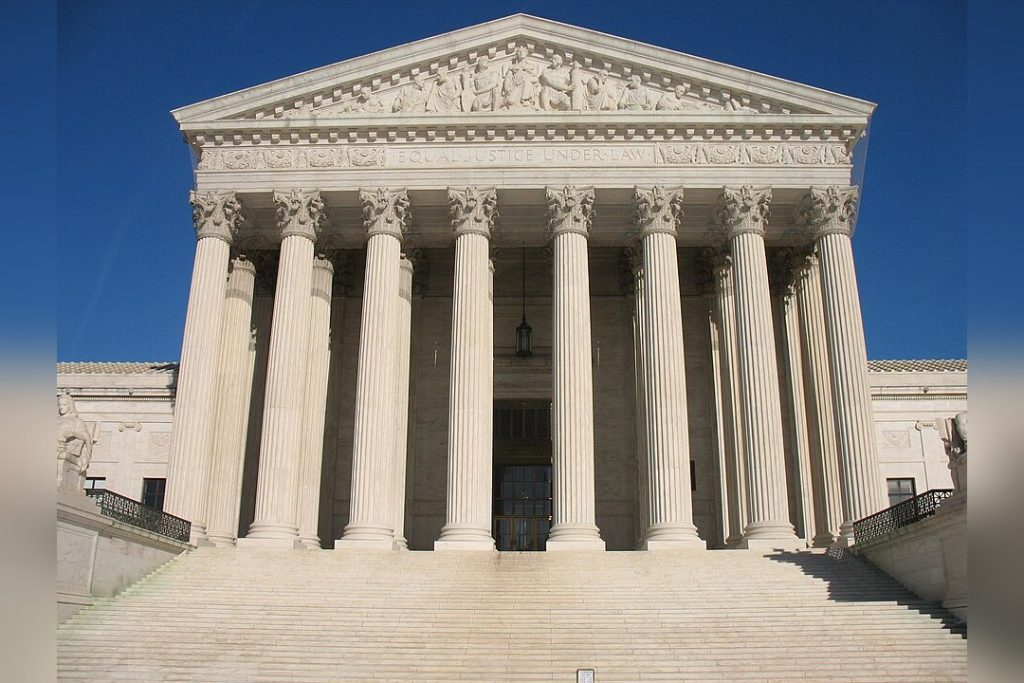
WASHINGTON, October 15 — The Supreme Court is considering a request to block an order by the U.S. Court of Appeals for the 4th Circuit, which directed the Federal Communications Commission (FCC) to decide on a challenge to its public notice that would extend favorable advertising rates to political parties and committees. The dispute centers around federal election law, which grants preferential rates to candidates for federal office during the 45-day period before the primary election and the 60-day period before the general.
On March 30, 2026, the FCC’s Media Bureau issued a public notice indicating that political parties and joint fundraising committees should also receive the favorable rates. The case was brought to the Supreme Court by the National Republican Senatorial Committee and the National Republican Congressional Committee, who argue that the 4th Circuit did not have the power to consider the challenge.
The National Republican Senatorial Committee and the National Republican Congressional Committee claim that the 4th Circuit overstepped its authority by considering the challenge. They argue that only the FCC has the power to decide on the public notice. As of October 15, the Supreme Court has yet to make a decision on the request to block the order by the U.S. Court of Appeals for the 4th Circuit.
The decision could have significant implications for political advertising during federal elections. The Supreme Court’s decision could set a precedent for how federal election law is interpreted and enforced.
As the 2026 midterm elections approach, the case could have far-reaching consequences for political parties and committees seeking to advertise during the election period. Stay tuned to InfoPulse Today for updates on this developing story.
Sources
Background and why it matters
The Federal Communications Commission was created in 1934 through the Communications Act, which consolidated federal oversight of telephone, telegraph, and radio communications under a single independent agency. It replaced the earlier Federal Radio Commission and assumed responsibility for regulating wire communications previously handled by the Interstate Commerce Commission. Over time, its authority expanded to include emerging technologies such as television, satellite, and broadband internet, reflecting the evolving nature of national communications infrastructure.
The FCC is an independent federal agency tasked with regulating interstate and international communications by radio, television, wire, satellite, and cable across all U.S. states, territories, and the District of Columbia. Its core mission centers on ensuring equitable access to communication services while supporting national defense and public safety through reliable wire and radio systems.
The agency operates under the direction of five presidentially appointed commissioners, confirmed by the Senate, who serve staggered five-year terms with no more than three from the same political party. This structure is designed to promote stability and nonpartisan oversight in regulatory decisions that affect media ownership, spectrum allocation, and consumer protections in telecommunications.
Understanding the FCC’s role is essential because its rulings shape how political entities access communication channels during election cycles. The current legal dispute involves the interpretation of federal election law regarding advertising rates, a matter where the FCC’s authority over broadcast and cable media directly intersects with campaign finance regulations. As election-related media access remains a recurring point of legal and public debate, the FCC’s decisions continue to influence the conditions under which political speech is disseminated to the public.




