
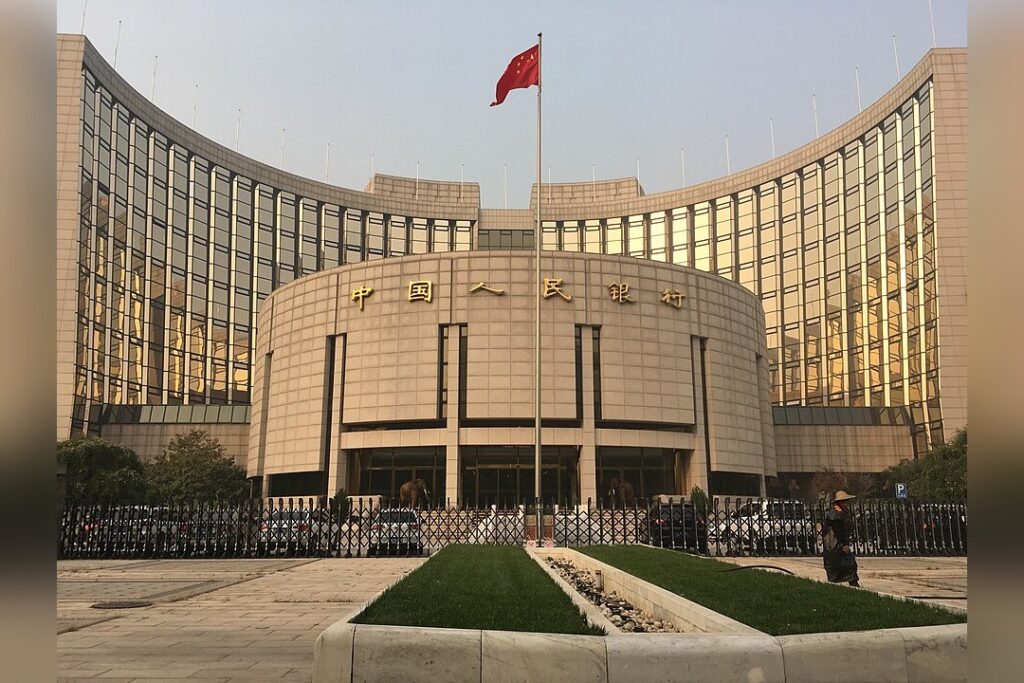
BEIJING, July 10 — For Indian businesses and policymakers tracking Asia’s monetary evolution, the sheer scale of China’s digital yuan experiment is becoming impossible to ignore. The People’s Bank of China (PBOC) began developing its central bank digital currency (CBDC) back in 2014, and the pilot for what is officially called the e-CNY launched in 2020. By 2024, cumulative transactions in the digital yuan had already crossed the $1 trillion mark, according to PBOC data.
That figure alone signals a shift in how the world’s second-largest economy handles payments. The pilot has now expanded to cover more than 26 cities, including financial hubs like Beijing, Shanghai, Shenzhen, and Chengdu.
Officials say the population covered by the pilot exceeds 260 million people. The architecture of the digital yuan is what analysts call a two-tier system. The PBOC issues the digital currency to commercial banks, which then distribute it to the public.
This design is deliberate. It is meant to replace some physical cash in circulation and give the central bank a more direct channel for monetary policy transmission.
For a market like India, where cash still dominates large swaths of the economy, the implications are worth watching. As of 2025, the digital yuan is not a fully launched nationwide currency. It remains in what the PBOC describes as advanced testing.
But that testing covers three distinct areas: domestic retail payments, cross-border trade, and government salary payments. Each of these use cases has direct relevance for Asian trade partners and supply chain participants. The cross-border trade angle is particularly significant for Indian importers and exporters dealing with Chinese goods.
If the digital yuan gains traction in trade settlement, it could alter the currency dynamics of bilateral commerce. Analysts note that a digital currency issued by a central bank offers different transparency and control characteristics compared to private stablecoins or traditional bank wires.
Domestically, the PBOC’s push to pay government salaries in e-CNY is a powerful adoption driver. When civil servants receive their wages in digital yuan, they must use the wallet and the infrastructure. That creates a captive user base and normalizes the technology in everyday transactions.
It is a strategy that other central banks in Asia are studying closely. For India, the digital yuan’s progress comes at a time when the Reserve Bank of India is itself advancing its own CBDC pilot, the digital rupee.
The two projects share some design principles — both are two-tier systems, both aim to reduce cash dependency — but they operate in very different regulatory and market environments. The sheer scale of China’s pilot, covering a population larger than that of any single European nation, gives the PBOC a data advantage in understanding how CBDCs behave at scale. The PBOC has not announced a firm date for a full national rollout.
But the trajectory is clear. The pilot has moved from a small experiment in a few cities to a program covering hundreds of millions of people and trillions of yuan in transaction volume. Officials have indicated that the technology is mature enough for the advanced testing now underway.
What comes next is likely to be a gradual expansion rather than a sudden switch. The digital yuan will not replace all physical cash overnight, but it is designed to replace some of it.
For businesses across Asia, including those in India, understanding how this system works — and how it might interact with their own payment rails — is becoming less a matter of curiosity and more a matter of competitive positioning. The market angle is straightforward. A digital currency that handles over a trillion dollars in transactions, covers a quarter of a billion people, and is backed by the world’s second-largest central bank is not a pilot in the traditional sense.
It is a live experiment at near-production scale. For Indian finance ministries, trade bodies, and tech firms, the watchword is engagement — understanding the architecture, the data flows, and the potential interoperability points before the system becomes too entrenched to adapt to.




