
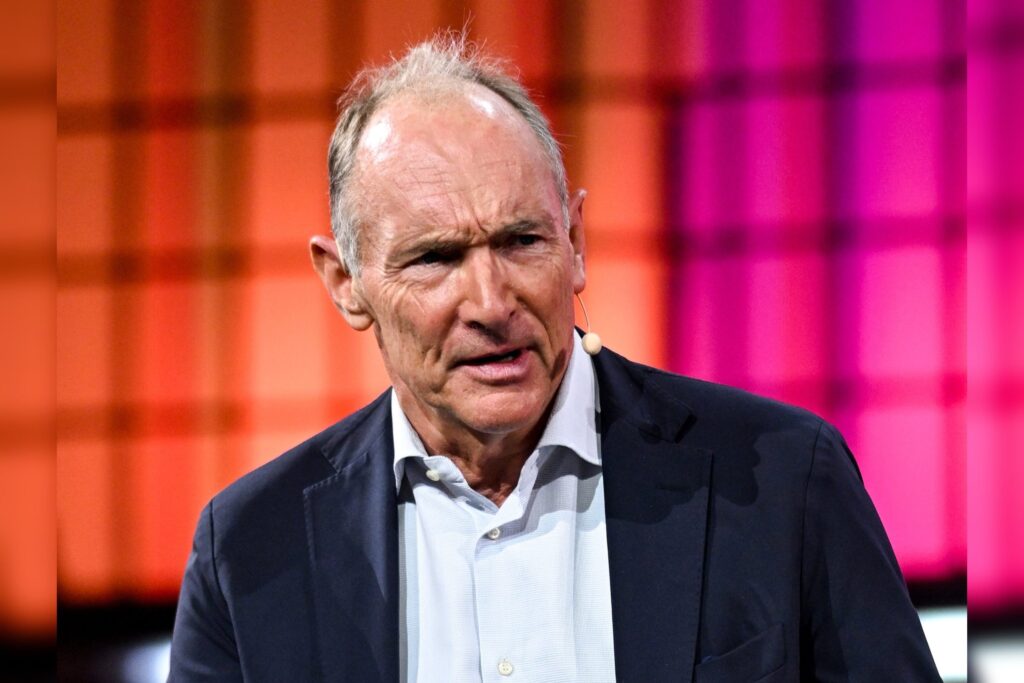
LONDON, July 14 — There is a quiet persistence to Tim Berners-Lee that has defined the digital age, and against this backdrop of constant technological upheaval, his name remains the foundational reference point for how the modern world communicates. Born in London on June 8, 1955, Berners-Lee was the architect of a system that would redraw the map of human interaction. In 1989, while working at the European Organization for Nuclear Research, better known as CERN, he invented the World Wide Web.
What is at stake in that single achievement is difficult to overstate. He created the core technologies that made the web function: HTML, the markup language for structuring pages; HTTP, the protocol for transferring data; and the first web browser, which allowed users to navigate this new digital territory.
These were not abstract theories; they were working tools.
From Geneva to Global Governance
The wider picture, however, required structure. In 1994, Berners-Lee founded the World Wide Web Consortium (W3C) at the Massachusetts Institute of Technology. This body became the corridors of power for setting the standards that keep the web interoperable, preventing it from fracturing into proprietary fiefdoms.
His work was recognised with a knighthood in 2004, a formal acknowledgment of a contribution that had already reshaped commerce, culture, and communication. Yet Berners-Lee did not stop at invention.
In 2009, he launched the World Wide Web Foundation, an organisation dedicated to promoting universal web access. For him, the technology was only as meaningful as its reach. He has been a vocal advocate for net neutrality, arguing that all data on the internet should be treated equally by service providers, and has spoken out against internet censorship, seeing these forces as direct threats to the open platform he helped create.
A New Chapter for Data Sovereignty
By 2018, Berners-Lee was turning his attention to a problem he had long foreseen: the centralisation of data. He introduced the Solid project, an initiative designed to decentralise web data. The goal is to give individuals control over their own information rather than surrendering it to large corporate platforms.
In the corridors of tech policy, this is seen as a potential paradigm shift, a move to rebalance the relationship between the user and the service. In 2016, he received the Turing Award, often described as the Nobel Prize of computing.
It was a formal capstone on a career that had already fundamentally altered the course of human history. What is at stake now, as the Solid project develops and debates over data ownership intensify, is whether the inventor of the web can also help steer its next evolution. The wider picture remains unfinished, and Berners-Lee, now in his eighth decade, is still writing the code.




