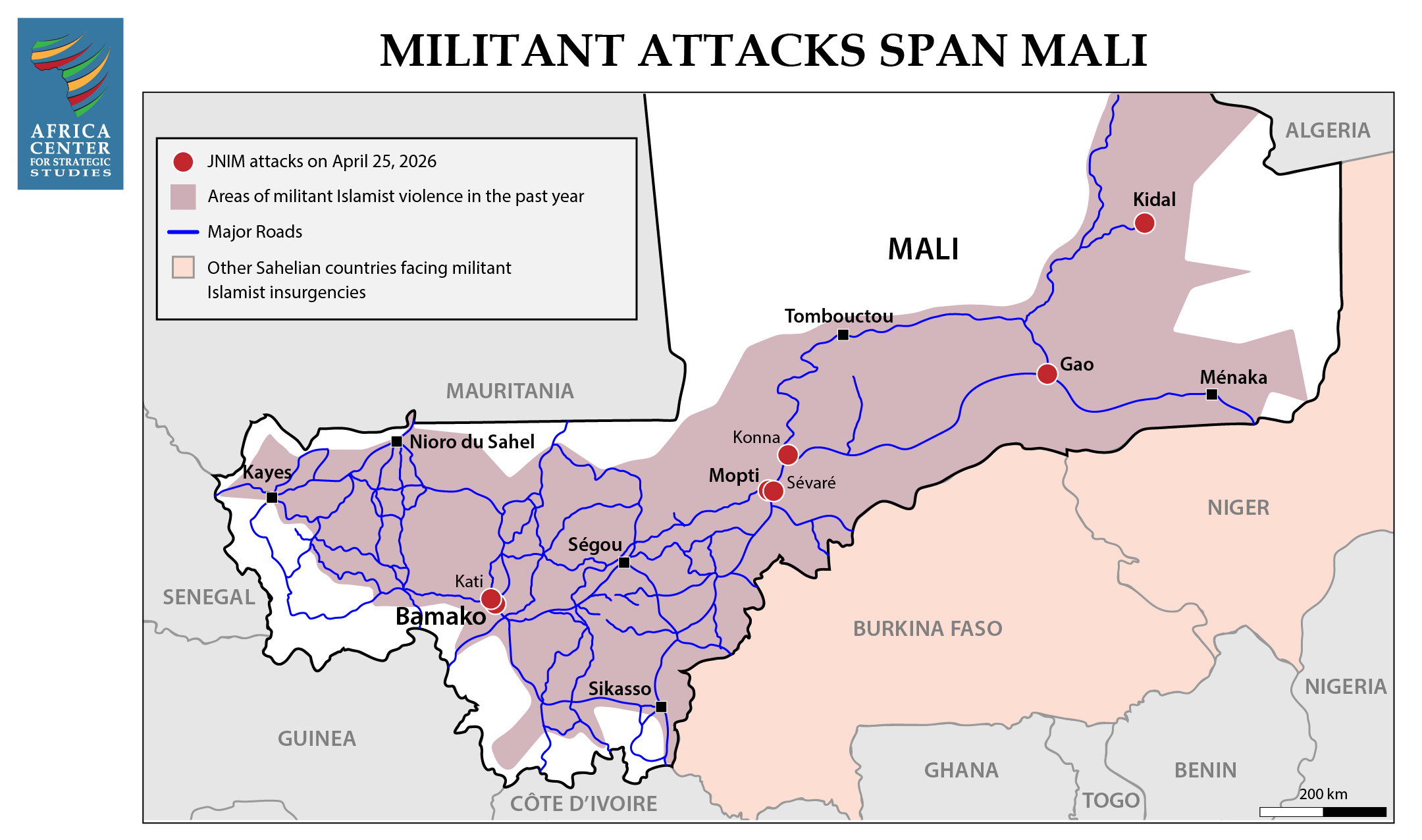
A series of coordinated attacks launched by the Azawad Liberation Front (FLA) and Jama’at Nusrat al-Islam wal-Muslimin (JNIM) on April 25, 2026, have rocked multiple locations across Mali, marking the largest offensive in the Mali War since the 2012 rebellion. The JNIM fighters targeted key cities, including Bourem, Bamako, Kati, Sévaré, Senou, and Mopti, while the FLA claimed control of Kidal and parts of Gao. The Islamic State’s Sahel Province (IS-SP) also seized the opportunity to launch its own attacks, taking advantage of the chaos created by the FLA-JNIM offensive.
The attacks have resulted in significant casualties, including the killing of Defense Minister Sadio Camara and the injury of intelligence chief Modibo Koné. The targeting of government centers in Bamako and Kati suggests a deliberate attempt to destabilize the Malian government. The FLA and JNIM have a history of cooperation, and their joint attacks in Azawadi-claimed territory have been particularly effective. However, in southern and central Mali, JNIM has acted independently, launching solo attacks that have caught the government off guard.
The Malian government and Russia’s Africa Corps have described the attacks as a coup attempt that has been thwarted. However, the withdrawal of Malian troops and Russia’s Africa Corps from key locations, including Kidal, Aguelhok, and Tessalit in the Kidal Region, as well as Tessit in the Gao Region and Ber in the Tombouctou Region, raises questions about the effectiveness of their response. The situation on the ground remains fluid, with the FLA and JNIM continuing to launch attacks and the government struggling to regain control.
The involvement of the Islamic State’s Sahel Province (IS-SP) adds a new layer of complexity to the conflict. The group’s ability to launch attacks under the cover of the FLA-JNIM offensive suggests a level of coordination and planning that is troubling. The IS-SP has been active in the region for several years, and its presence has contributed to the instability and violence that has plagued Mali. The US government, which has been supportive of the Malian government’s efforts to combat terrorism, will likely be watching the situation closely, given the potential implications for regional stability.
Regional Implications
The attacks in Mali have significant implications for the region, particularly in terms of the spread of extremist ideology and the potential for further instability. The ability of the FLA and JNIM to launch coordinated attacks across multiple locations suggests a level of sophistication and planning that is concerning. The involvement of the IS-SP adds to the complexity of the situation, and the potential for further violence is high. As the situation continues to unfold, it will be important to watch for any signs of escalation or expansion of the conflict into neighboring countries.
As the US and its allies consider their response to the situation in Mali, they will need to balance their support for the Malian government with the need to address the underlying causes of the conflict. This will require a nuanced approach that takes into account the complex web of relationships between the various groups involved, as well as the historical and cultural context of the region. The US President will likely be working closely with regional leaders and international partners to develop a coordinated response to the crisis, one that addresses the immediate needs of the Malian people while also working to prevent further instability in the region. As the situation continues to evolve, it will be important to watch for any signs of progress or escalation, and to consider the potential implications for regional stability and global security.
Looking ahead, the key will be to watch for any signs of further escalation or expansion of the conflict. The ability of the FLA and JNIM to launch coordinated attacks, combined with the involvement of the IS-SP, suggests a high level of risk. The international community will need to remain vigilant, working to support the Malian government and prevent further instability in the region. As the situation continues to unfold, it will be important to consider the potential implications for regional stability and global security, and to work towards a resolution that addresses the underlying causes of the conflict and promotes lasting peace and stability in the region.