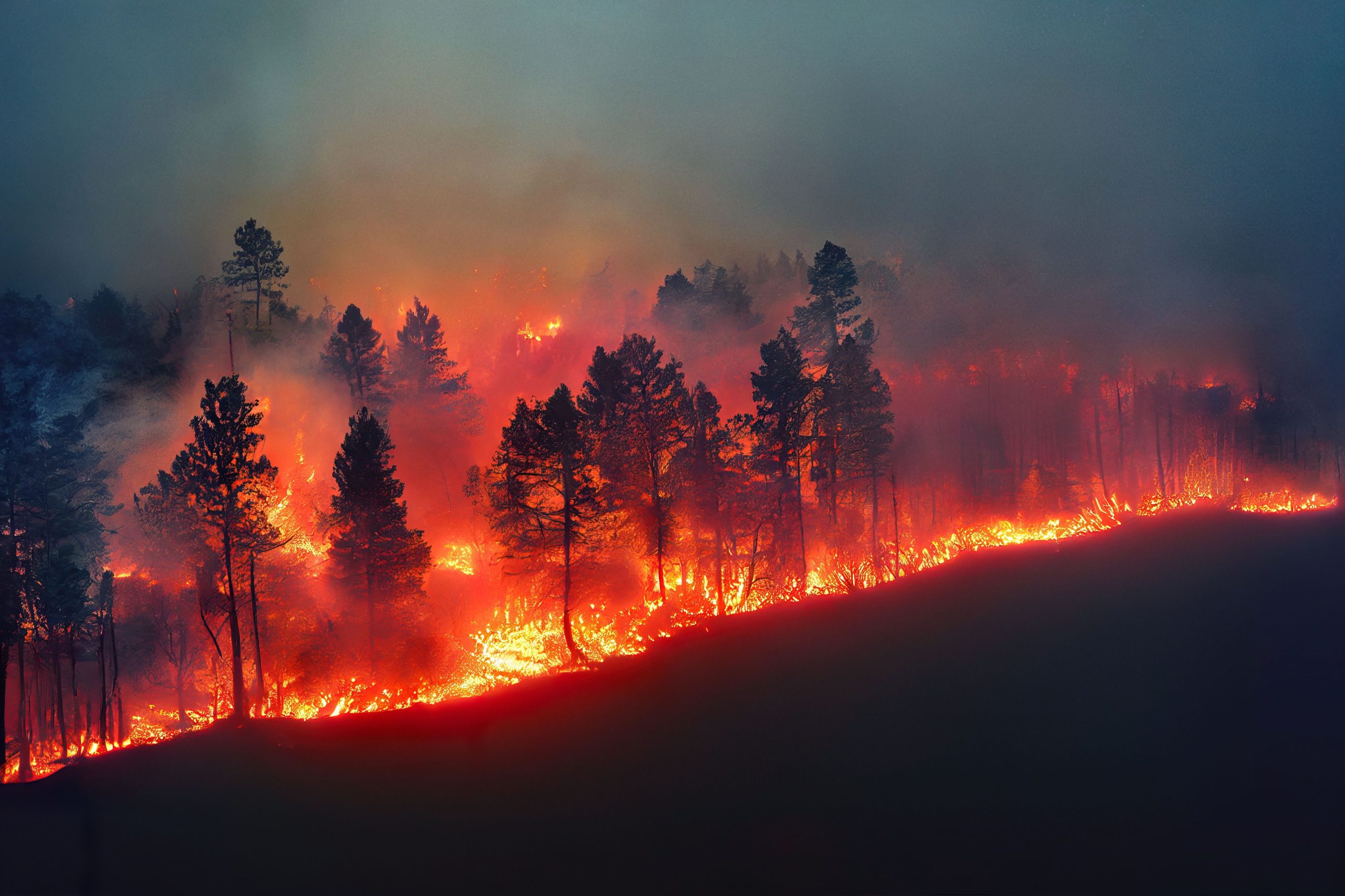
A new study published in Science Advances on April 3, 2022, warns that the U.S. West will face a dramatic increase in the one-two punch of wildfires followed by heavy downpours that trigger flooding and mudslides. Researchers found that under a worst-case climate change scenario, this fire-flood combination could increase eight-fold in the Pacific Northwest, double in California, and rise about 50% in Colorado by the year 2100. The study analyzed 11 Western states, focusing on four where the projected increase was most pronounced.
The science behind the double whammy
The study examined how human-caused climate change intensifies the relationship between extreme fire events and subsequent heavy rainfall. Researchers found that 90% of extreme fire events will be followed by at least three extraordinary downpours in the same location within five years. This happens because even as the West gets drier overall, making wildfire season longer, concentrated bursts of intense rain are increasing and arriving earlier in the year. Areas can get hit by both extremes in quick succession.
“One disaster is bad. Two disasters in rapid succession are even worse because you’re already reeling from the first one,” said study co-author Samantha Stevenson, a climate scientist at the University of California Santa Barbara. “But in the particular case of wildfire plus extreme rain, the wildfire is setting you up for worse consequences because you’re losing your vegetation, you’re changing soil properties and making that landscape more conducive to destructive flooding.”
Real-world examples of the pattern
Stevenson pointed to the Thomas Fire, which started in late 2017 in Southern California. A month later, a downpour of half an inch of rain in just five minutes caused mudslides in Montecito that killed 23 people. “Oh yeah, it was crazy,” Stevenson said. “Like the entire highway was blocked off with like a wall of mud. There were boulders in people’s living rooms.”
For study co-author Daniel Swain, a western weather expert at UCLA who lives in Colorado, the threat hit even closer to home. He had to evacuate his Boulder home because of a fire last week. The day the study was published marked the start of the flash flood season in that region.
Swain noted that especially in the Pacific Northwest, fire and flood seasons keep getting longer and closer to each other. Both are likely to get worse, but extreme rainfall should increase more. “That’s another sort of a double whammy, a situation where you have the candle burning at both ends,” Swain said. “It’s entirely foreseeable that some of these places will literally still have fires burning when the first extreme rainfall event extinguishes them.”
Study limitations and realistic scenarios
The study authors acknowledged that the worst-case warming scenario they used, which relied on dozens of large-scale climate model simulations, is becoming increasingly less likely. Many countries, including the United States and Europe, have been cutting emissions of heat-trapping gases. However, not all nations are doing so.
Study lead author Danielle Touma, a climate scientist at the National Center for Atmospheric Research, said they were unable at the time to use simulations of more likely scenarios with some moderate emission reductions. But in those more realistic scenarios, the Pacific Northwest would probably still see a four-fold increase in fire and flooding.
The simulations focused on fire weather conditions, not fires themselves, and downpour conditions. LeRoy Westerling, a climate scientist at the University of California at Merced who was not part of the study, said he worries about the accuracy of global computer model simulations being able to work on such a small scale. Still, he said the results make sense.
The study examined 11 Western U.S. states but concentrated on four where the projected increase in fires followed by downpours was most noticeable. These included California, Oregon, Washington, and Colorado.
The fire-flood sequence creates a dangerous feedback loop. Burned landscapes lose vegetation that holds soil in place. The heat from fires changes soil properties, making it less able to absorb water. When heavy rain hits these denuded areas, water runs off quickly, carrying ash, mud, and debris downhill. This can overwhelm drainage systems and inundate communities that may still be recovering from the fire itself.
The study’s findings show a broader pattern in climate science: extreme events are not just becoming more frequent, but they are also clustering together in ways that compound their damage. Communities in the West will need to prepare for a future where fire season and flood season overlap, sometimes within the same month.
The research provides a stark picture of what lies ahead. Even with moderate emission reductions, the Pacific Northwest could see a four-fold increase in the fire-flood sequence. That means more homes at risk, more lives disrupted, and more communities forced to rebuild after back-to-back disasters. The study makes clear that the window for action is narrowing.