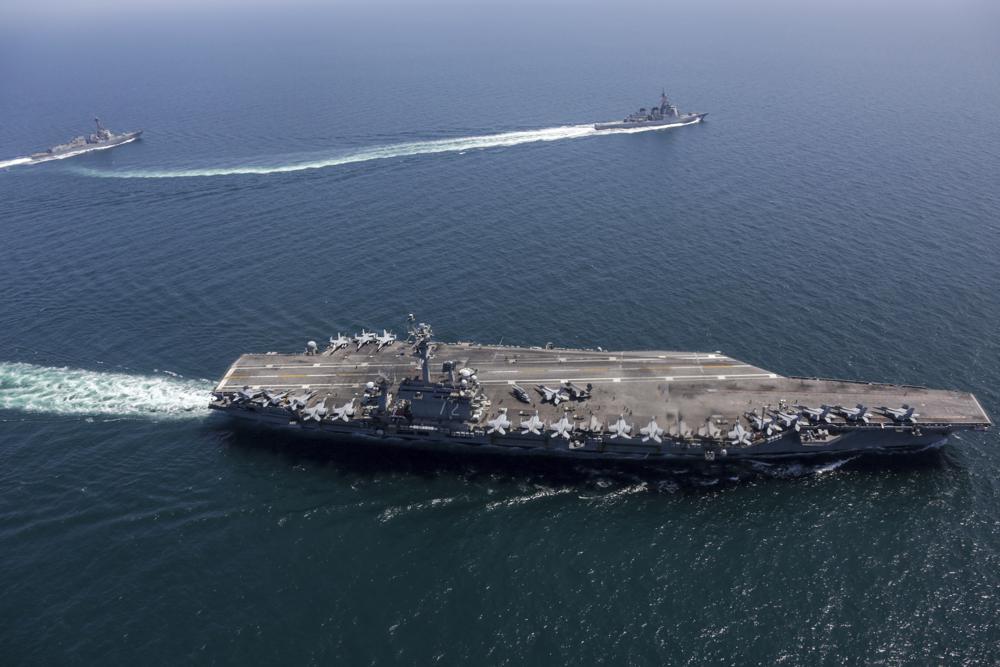
For residents living in the coastal towns of Japan and the Korean Peninsula, the sound of naval ships and aircraft has become a familiar presence in recent days. The joint naval exercise conducted by the U.S. and Japanese warships, led by the USS Abraham Lincoln carrier strike group, has brought a sense of unease to the communities in the region. The exercise, which took place in the waters between Japan and the Korean Peninsula, is a show of the close military alliance between the two countries amid growing speculation of North Korea’s missile or nuclear testing later this week.
The U.S. 7th Fleet and Japan’s Maritime Self-Defense Force conducted the joint naval exercise at the Sea of Japan on Tuesday and Wednesday, marking the first time the U.S. aircraft carrier has held the exercise in the area since 2017. The exercise is seen as an apparent attempt to deter North Korea’s provocation, as defense experts have warned that North Korea may launch another missile or even conduct a nuclear test as early as this week. This week is particularly significant, as it marks the birth anniversary of North Korea’s founding leader Kim Il Sung, an event that has been associated with increased military activity in the past.
Regional Tensions on the Rise
Tension is rising in the region ahead of an annual joint military exercise between the United States and South Korea. Japan has also stepped up joint military exercises with its closest ally, the United States, as well as regional partners in recent years, amid rising concern over China’s increasingly assertive military actions in the regional seas. Japan’s Chief Cabinet Secretary Hirokazu Matsuno told reporters that the ongoing joint exercise is “aimed at strengthening military cooperation between Japan and the United States, and is not keeping in mind a specific country.” Matsuno emphasized that Japan will continue to strengthen the deterrence and response capability of the Japan-U.S. alliance and do its utmost for the defense of the country.
Details of the exercise will be released by the Japanese Defense Ministry “when the situation allows a disclosure.” Japan’s Maritime Self-Defense Force said its destroyer JS Kongo and JS Inazuma, as well as Japanese F-2 fighters, joined the USS Abraham Lincoln carrier strike group “in order to strengthen the capability of Japan-US alliance for effective deterrence and response.” The exercise is a significant display of military cooperation between the two countries, and its impact will be closely watched by neighboring countries, including North Korea and China.
North Korea’s Military Activity
Some experts say that North Korea’s recent missile tests were meant to perfect its weapons technology, boost its leverage in future negotiations with the U.S., and secure stronger internal loyalty. They say that North Korea could soon conduct another intercontinental ballistic missile (ICBM) launch, a launch of a satellite-carrying rocket, or a test of a nuclear device in the coming weeks. The international community is closely watching North Korea’s military activity, and the joint naval exercise between the U.S. and Japan is a clear signal that the two countries are committed to maintaining regional stability and security.
As the region waits with bated breath to see what North Korea will do next, the joint naval exercise between the U.S. and Japan serves as a reminder of the complex geopolitical dynamics at play in the region. The exercise is a demonstration of the strong military alliance between the two countries, and its impact will be felt for weeks to come. As the situation continues to unfold, it remains to be seen how North Korea will respond to the joint naval exercise, and what the consequences will be for the region.
What to Watch Next
As the joint naval exercise comes to a close, all eyes will be on North Korea to see if it will follow through on its threats to conduct another missile or nuclear test. The international community will be watching closely to see how the situation develops, and what the consequences will be for the region. The U.S. and Japan will likely continue to strengthen their military cooperation, and the region can expect to see more joint military exercises in the coming months. As the situation continues to unfold, it is clear that the region is in for a period of heightened tension and uncertainty, and it remains to be seen what the future holds for the people living in the coastal towns of Japan and the Korean Peninsula.