
Iran’s Threat to Gulf Undersea Cables Exposes a Fragile Global Internet Backbone
Iranian security officials have explicitly threatened to sever undersea internet cables and strike data centers in the Persian Gulf if hostilities with the US and Israel escalate. The warning targets fiber-optic routes crossing the Strait of Hormuz—home to $2 trillion in US-linked technology assets, according to Mohsen Rezaei, secretary of Iran’s Supreme National Security Council. The move underscores how easily regional conflicts could unravel the global internet’s hidden infrastructure.
Most international data—99% of cross-border traffic—still travels through undersea cables, not satellites. These cables, laid on the seabed since the 1850s, carry everything from stock trades to AI training data. Yet their vulnerability has grown as geopolitical tensions push sabotage from rare incidents to a calculated risk. The question is no longer *if* cables will be cut, but *when*—and how long the world can survive without them.
—
How Undersea Cables Work—and Why They’re Indispensable
Modern submarine cables use optical fiber to transmit data as pulses of light, replacing copper wires from earlier generations. A single cable, about the thickness of a garden hose, can carry terabits of data per second—enough for millions of simultaneous calls or transactions. The deepest sections weigh 1.4 tonnes per kilometer, while shore approaches use heavier armor to resist trawlers and anchors.
Despite satellite alternatives like Starlink, undersea cables remain the backbone of global finance. The New York Stock Exchange, for example, relies on cables landing in Virginia Beach to connect with European markets in milliseconds. A 2024 study by the Atlantic Council found that between 150 and 200 cables are damaged annually—mostly by fishing gear or shipping accidents—but repairs typically take days or weeks. Delays cascade: in 2024, the Russian-linked tanker *Eagle S* dragged its anchor for 56 miles, severing four data cables and Estonia’s sole undersea power link in what Finland called the “Christmas Day massacre.”
Cables also power cloud computing. Amazon, Microsoft, and Google operate data centers in Dubai and Abu Dhabi, routing traffic through Gulf routes. Hossein Shariatmadari, editor of Iran’s hardline *Kayhan* newspaper, argued in October that disrupting these cables could “undermine US technological competition with China” by crippling AI training pipelines and financial settlements.
—
A History of Sabotage: From Telegraphs to Today’s Gray-Zone Attacks
The first transatlantic cable, laid in 1858, failed after just three weeks when its gutta-percha insulation degraded. By 1872, every continent except Antarctica was linked—but the risks of sabotage were clear. During World War I, Germany mined cables to isolate Britain. In 1982, Argentina cut a UK-Falklands link to sever London’s intelligence feed.
Today’s threats are more precise. The *Yi Peng 3*, a Chinese cargo ship, damaged two Baltic cables in November 2024, though no charges were filed. Finland prosecuted officers of the *Eagle S* for the December cuts, but analysts note that prosecutions are rare when incidents occur in disputed waters. Iran’s threats follow a pattern: in 2019, Houthi forces—backed by Tehran—attacked Saudi oil tankers in the Gulf, a tactic now extended to digital infrastructure.
Mohsen Zanganeh, an Iranian parliamentarian, framed attacks as defensive: “Major technology companies operate data centers in Gulf states,” he told ANA news. “Disrupting their equipment would force the US to reconsider its military posture.” The strategy mirrors Russia’s 2022 cuts to Baltic cables, which delayed NATO communications during Ukraine’s counteroffensive.
—
The $2 Trillion Question: How Much Damage Would It Take?
Rezaei’s claim of $2 trillion in US-linked assets in the UAE and Strait of Hormuz includes data centers, cloud servers, and AI training hubs. While the figure lacks breakdowns, it reflects the region’s role as a hub for hyperscalers.
Cutting cables isn’t just about bandwidth. The Strait of Hormuz hosts 21 fiber routes, including the SEA-ME-WE 6 system, which links Asia to Europe. Disrupting even one could reroute traffic through longer, slower paths—adding latency that crashes high-frequency trading. In 2021, a cable outage in the Mediterranean forced banks to pause automated settlements for hours.
Iran’s threats also target AI. Training large language models requires petabytes of data, often routed through Gulf data centers. Shariatmadari’s call to use cables as “leverage” suggests Tehran views them as a non-military pressure point—one that could force US firms to halt operations without direct conflict.
Yet the risks aren’t one-sided. Iran’s own economy depends on Gulf connectivity. The Islamic Republic’s 2020 sanctions relief deal included exemptions for internet access, but targeted attacks could trigger retaliation. The Atlantic Council’s Elisabeth Braw warns that “gray-zone” sabotage—where intent is denied—is now the norm. “Prosecutions are rare,” she wrote, “because attribution is hard.”
—
What Comes Next: Monitoring, Redundancy, and the Race for Resilience
Cable operators are hardening infrastructure. Google’s *Equinix* and *SubCom* now bury cables deeper in high-risk zones, while military-grade repeaters detect cuts faster. But redundancy has limits: the Baltic’s *Estlink 2* was the only power cable between Finland and Estonia. When it failed, Nordic grids faced blackouts.
Governments are also mapping risks. The US State Department’s 2025 *Critical Infrastructure Report* flagged the Strait of Hormuz as a “chokepoint” for digital trade. Meanwhile, Iran’s threats have prompted Gulf states to accelerate private-sector resilience plans. Dubai’s *Internet Exchange Point* now offers backup routes via satellite, though latency remains an issue for crypto trading.
For now, the biggest vulnerability isn’t military action but complacency. The *Eagle S* and *Yi Peng 3* incidents show that even accidental damage can cripple networks. Iran’s explicit warnings suggest a shift: cables are no longer just infrastructure but potential weapons. The question for businesses and governments isn’t whether they’ll be targeted—but how long they can survive without them.
Sources
- Iranian Regime Threatens to Cut Undersea Internet Cables, Strike Gulf Data Centres and AI Facilities
- Submarine communications cable
- The Internet’s undersea backbone is slipping into the danger zone
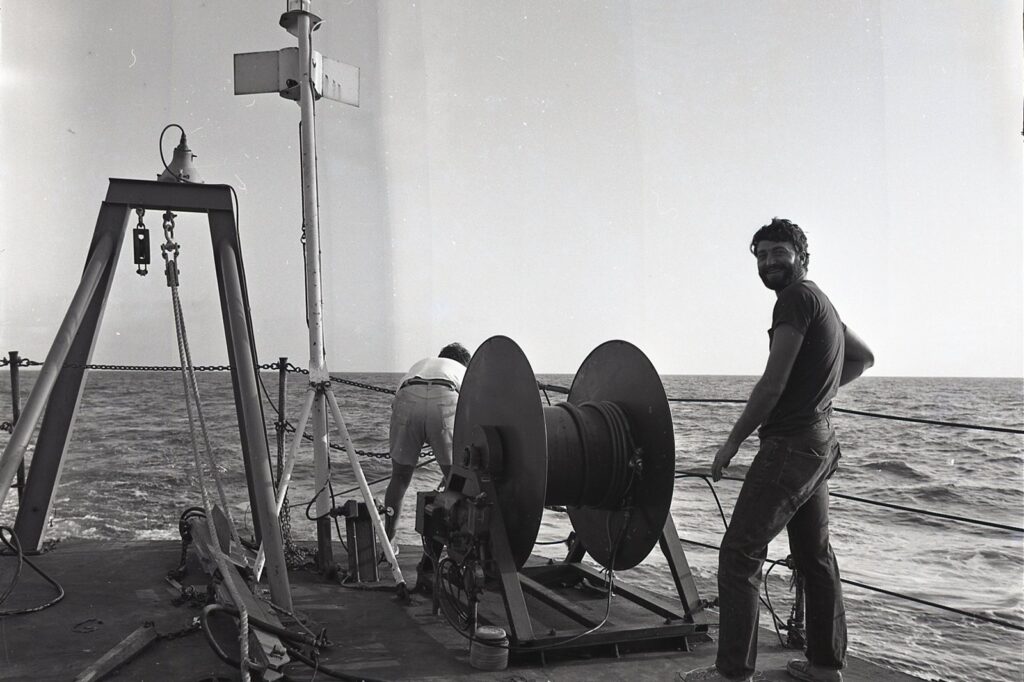
Photo: Credit Line: AIP Emilio Segrè Visual Archives, Gift of Bill Woodward, USNS Kane (CC0)




