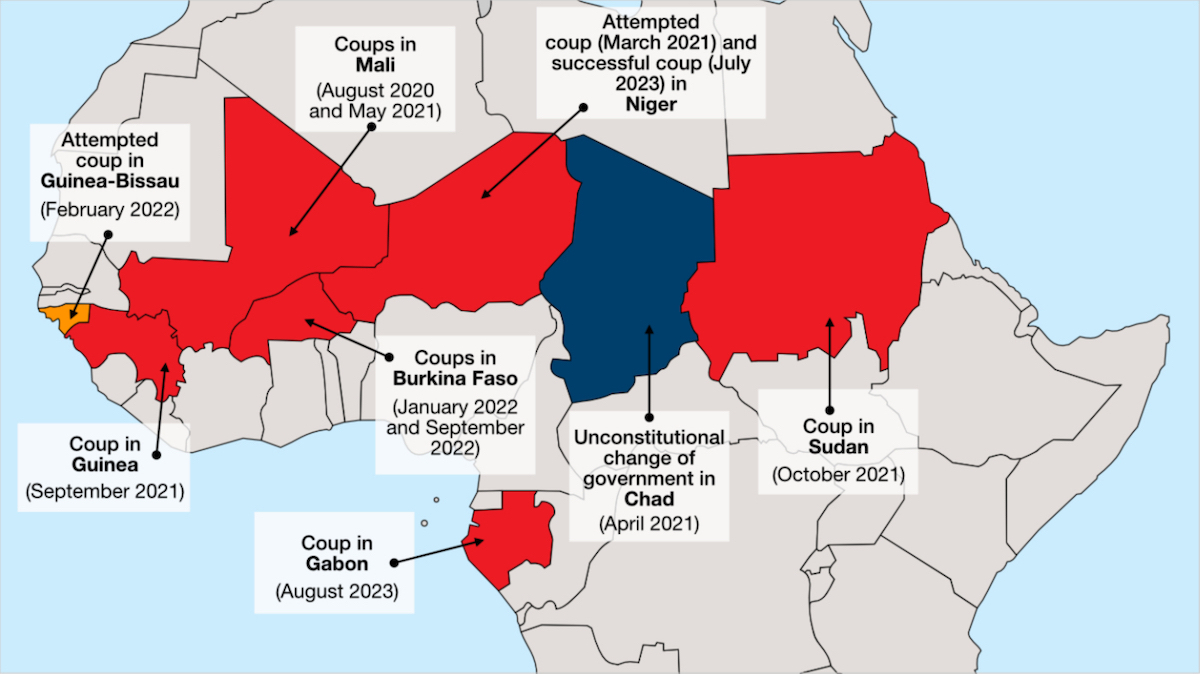
On August 2, 2023, the concept of the Coup Belt, a region in West Africa, Central Africa, and the Sahel, continues to be a significant geopolitical concern. This region has been plagued by a high prevalence of coups d’état, with the recent 2023 Nigerien coup being the latest example. The Coup Belt now forms a continuous chain stretching between the east and west coasts of Africa, highlighting the instability and volatility of the region.
The coups in the Coup Belt have shown similar characteristics, with most being led by dissatisfied militaries who criticize their governments’ handling of Islamic insurgents or protests. This criticism has been ongoing since 2003, with many militaries feeling that their governments have not done enough to address these issues. Additionally, resentment over French military, financial, and political influence over African governments has also played a significant role in the coups. The French have historically been involved in the region, particularly through Operation Barkhane, which aimed to help countries fight against Islamic insurgents.
However, the incoming juntas in the Coup Belt have tended to have worse relations with the West, seeking support from other countries instead of France. Many have turned to Russia and the Wagner Group, or Turkey, for support, marking a shift away from traditional Western alliances. This shift has significant implications, particularly for Ukraine, which is currently at war with Russia. Ukraine has begun to fund opposition groups in the region, leading to a proxy war between Russia and Ukraine in Africa. This development has further complicated the already volatile situation in the Coup Belt.
The involvement of external actors, such as Russia and Ukraine, has added a new layer of complexity to the situation in the Coup Belt. The region is now a battleground for influence, with different countries vying for power and control. This has significant implications for the stability and security of the region, as well as for the global community. The Coup Belt has become a critical area of concern, with the potential for further instability and conflict.
Regional Implications
The Coup Belt has significant implications for the region, with the potential for further coups and instability. The chain of countries affected by coups now stretches from the east to the west coast of Africa, highlighting the widespread nature of the problem. The region is home to many countries with fragile governments and economies, making them vulnerable to instability and conflict. The Coup Belt has also become a concern for neighboring countries, which fear the potential for instability to spread across borders.
The international community has a significant role to play in addressing the issues in the Coup Belt. The region requires a coordinated and sustained effort to address the underlying causes of the coups, including poverty, corruption, and lack of governance. The international community must also work to prevent external actors from exploiting the situation for their own gain, and instead, support the development of stable and democratic governments in the region. As the situation in the Coup Belt continues to evolve, it is essential to watch for further developments and to be prepared to respond to any new challenges that may arise.
Looking ahead, it is crucial to monitor the situation in the Coup Belt closely, as the region remains volatile and prone to further instability. The international community must be prepared to respond to any new developments, and to work towards a long-term solution to the issues in the region. The Coup Belt is a complex and challenging issue, requiring a sustained and coordinated effort to address. As the situation continues to unfold, it is essential to remain vigilant and to be prepared for any eventuality, ensuring that the region receives the support and attention it needs to achieve stability and security.