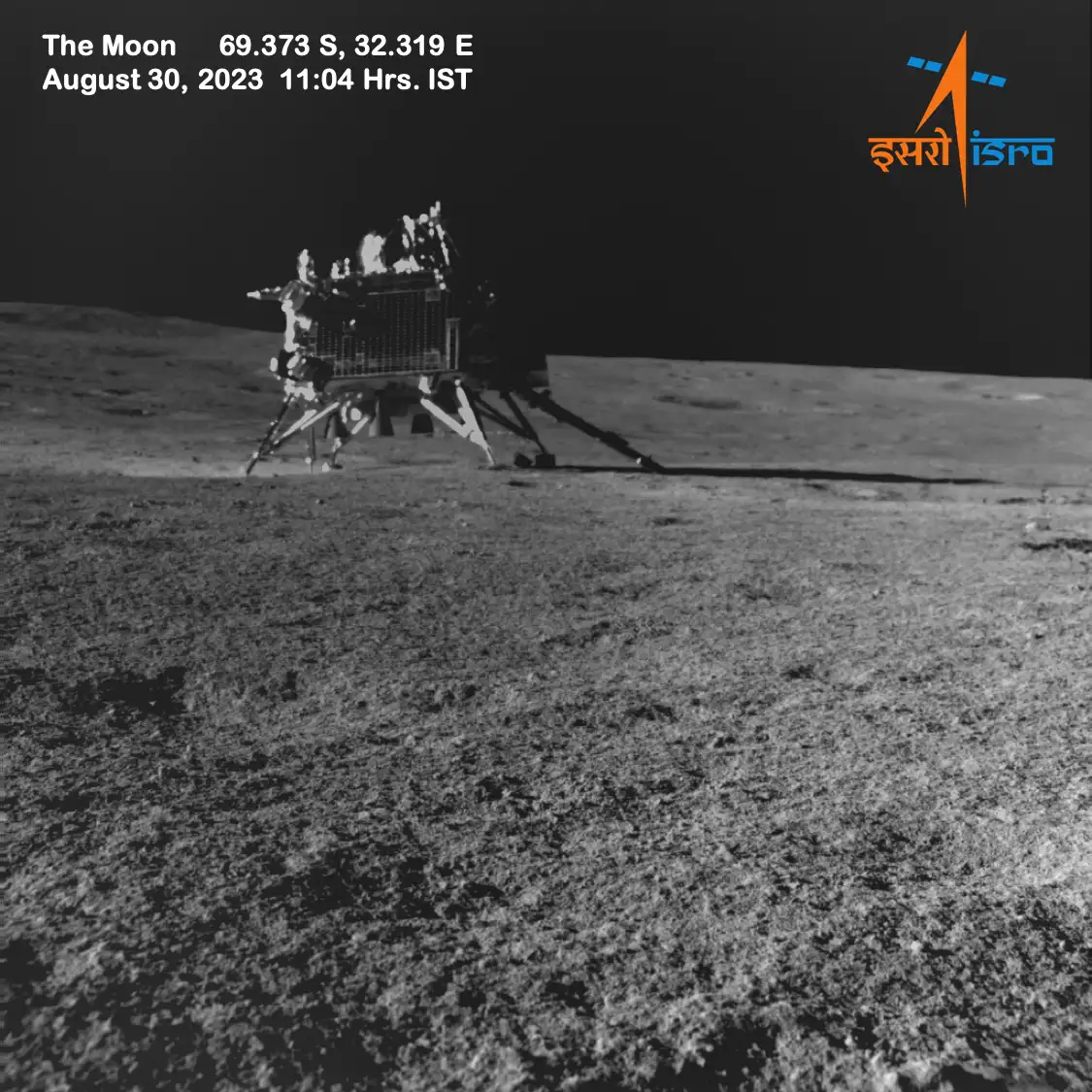
India has made history with the successful soft landing of Chandrayaan-3 near the Moon’s South Pole, marking the country’s first landing on the lunar surface. This achievement is a significant milestone for the Indian Space Research Organisation (ISRO) and a major breakthrough in the nation’s space exploration programme. The landing, which took place on August 23, 2023, at 18:04 IST, is a testament to India’s growing capabilities in space technology and its determination to push the boundaries of scientific discovery.
The Chandrayaan-3 mission, which was launched on July 14, 2023, from the Satish Dhawan Space Centre in Sriharikota, India, consists of a lunar lander named Vikram and a lunar rover called Pragyan. These components were designed to replace the equivalents on Chandrayaan-2, which had crashed on landing in 2019. The spacecraft entered lunar orbit on August 5 and has been orbiting the Moon since then, paving the way for the historic landing. With this achievement, ISRO has become the fourth national space agency to successfully land on the Moon, after the Soviet space program and NASA.
Technical Achievements
The soft landing of Chandrayaan-3 near the lunar South Pole is a complex technical feat that requires precise calculations and control. The lunar lander, Vikram, was designed to separate from the orbiter and descend to the lunar surface, while the lunar rover, Pragyan, will conduct scientific experiments on the Moon’s surface. The landing site, located at 69°S, is a unique and challenging environment, with extreme temperatures and rugged terrain. The success of the mission demonstrates India’s capabilities in designing and executing complex space missions.
The Chandrayaan programme, which was initiated by ISRO, aims to explore the Moon and its resources. The programme has been instrumental in advancing India’s space technology and has paved the way for future missions to the Moon and beyond. The success of Chandrayaan-3 has significant implications for India’s space programme, as it demonstrates the country’s ability to design and execute complex space missions. This achievement is expected to inspire a new generation of scientists and engineers in India and will likely have a positive impact on the country’s space industry.
As the world watches India’s historic achievement, the possibilities for future space exploration seem endless. The success of Chandrayaan-3 has opened up new avenues for scientific research and discovery, and ISRO is likely to build on this achievement in the coming years. With its growing capabilities in space technology, India is poised to become a major player in the global space industry. The country’s space programme is expected to drive innovation and economic growth, and its achievements will likely have a significant impact on the global space community.
As India celebrates this historic achievement, the focus is already shifting to the next phase of the mission. The lunar rover, Pragyan, will conduct scientific experiments on the Moon’s surface, providing valuable insights into the lunar geology and environment. The data collected by the rover will be transmitted back to Earth, where it will be analyzed by scientists and researchers. The success of Chandrayaan-3 has marked a new era in India’s space exploration programme, and the country is likely to continue pushing the boundaries of scientific discovery in the years to come. With its innovative approach and determination to succeed, India is poised to make a significant impact on the global space industry, and its achievements will likely inspire a new generation of scientists and engineers around the world.